by Kelley Rae
A Rose and an Amaranth blossomed side by side in a garden, and the Amaranth said to her neighbor, “How I envy you your beauty and your sweet scent! No wonder you are such a universal favorite.” But the Rose replied with a shade of sadness in her voice, “Ah, my dear friend, I bloom but for a time: my petals soon wither and fall, and then I die. But your flowers never fade, even if they are cut; for they are everlasting” (Aesop’s Fables, Sixth Century).
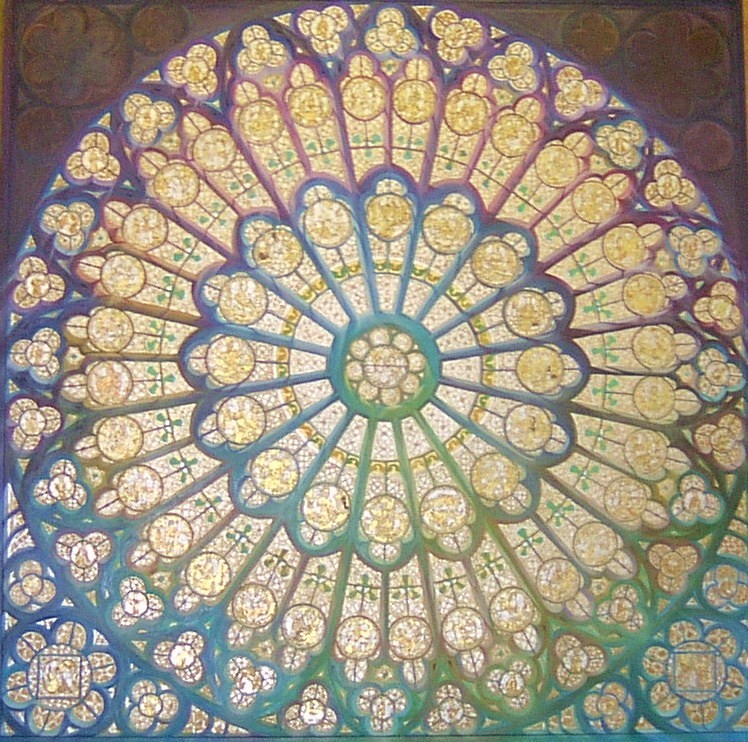
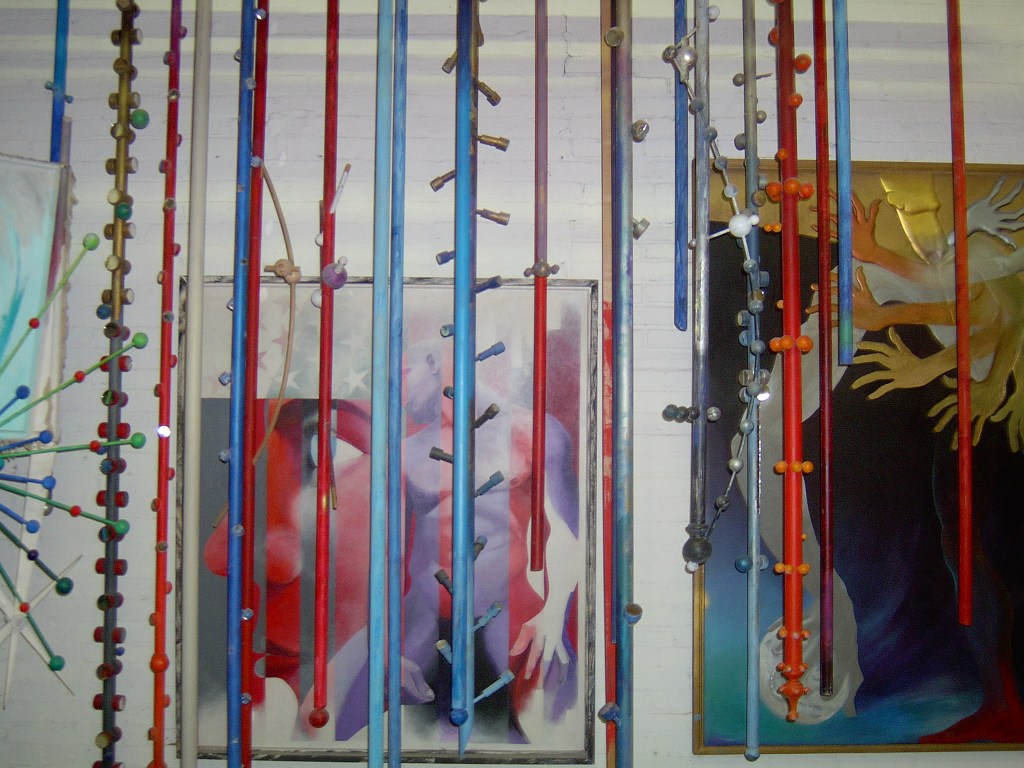
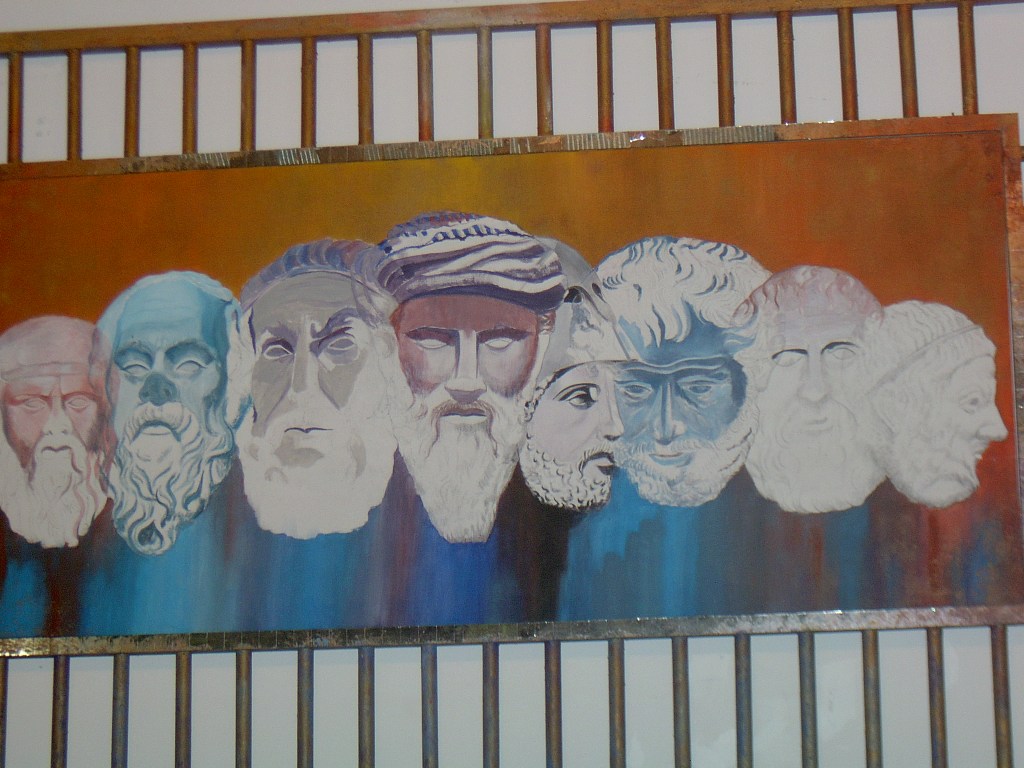
The day I went to see visionary artist Charles Leslie (Les) Harris to speak with him about his work, I did not know I would be conducting his last interview. I was given the assignment for my graduate Creativity Class, concerning the topic of the process of creative mind. As a writer, I was to look at the way another artist pursues his process. And so with notepad in hand and my Sony digital camera, I drove to a section of Baltimore I was not familiar with: the Clipper Mill area between Druid Hill Park and Hooper and Rockrose Park.
It was a late fall day in 2007 and like most Maryland fall days, it was raining. The renovated warehouse district where his gallery is now housed is trendy and hip. Les probably didn’t even know that and even if he did, he wouldn’t have cared. His version of reality was all that mattered to him, a trait I admire in others.
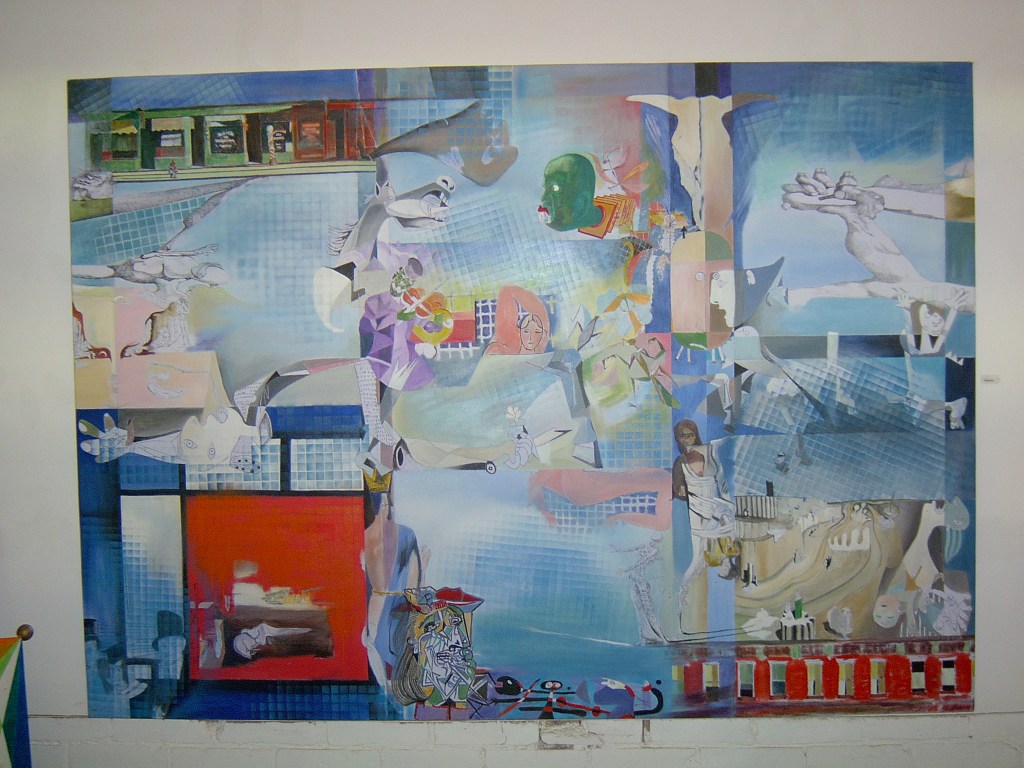
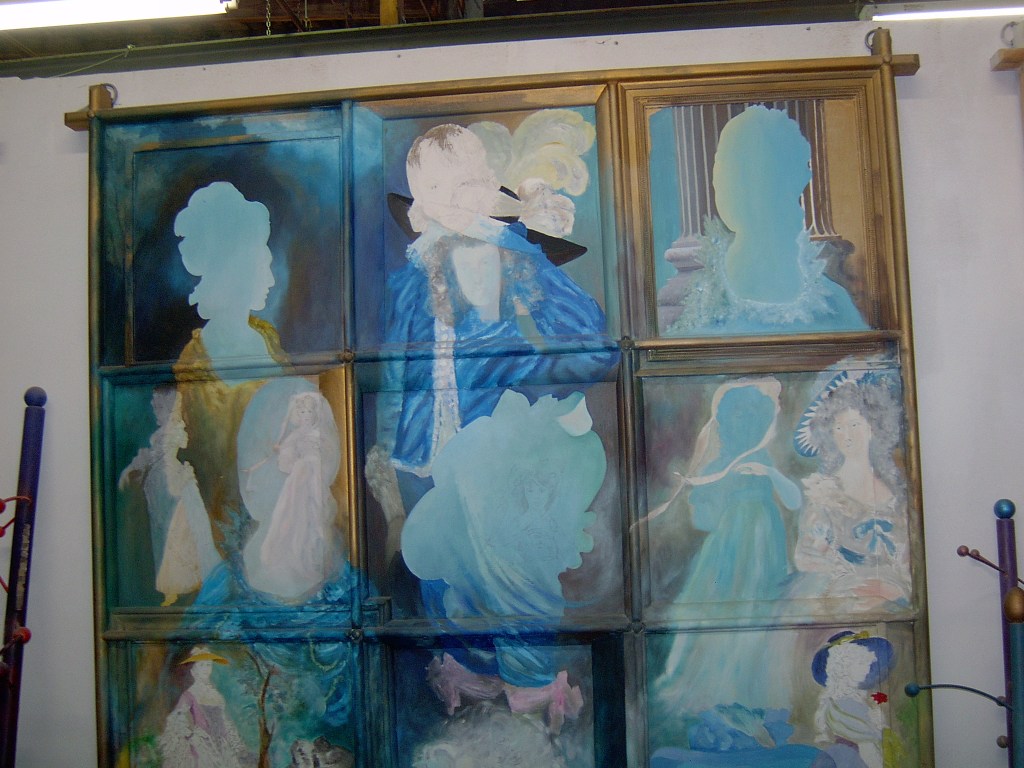
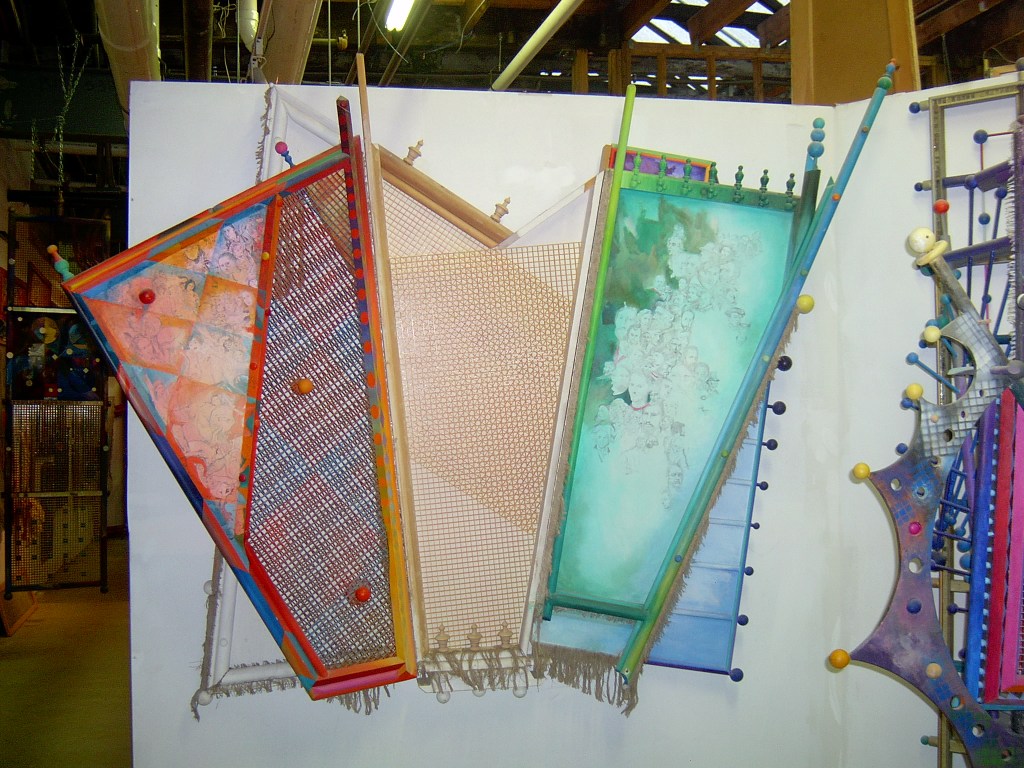
His perspective comes from a man who was born and lived in the Hampden area of Baltimore, Maryland, very near where his gallery is—an area traditionally blue collar yet nonetheless has experienced a renaissance of creativity and avant garde storefronts and cafes in the past fifteen years. The embodiment of this diverse neighborhood, Les welded ships during World War II, and then served under General Patton as a Communications Officer on the front lines where he was a witness to the Battle of the Bulge. Afterward, having graduated from the Maryland Institute of Art and Johns Hopkins where he majored in Humanities, he went to New York City and studied acting and dance at the American Theatre Wing. Having danced for the Metropolitan Opera, Les went on to study with artist Charles Rain, exhibiting at the Alexander Iolas Gallery. Once Les returned home, he began to teach and committed the rest of his time to his work, bringing home with him the images of the world he had seen during his enlistment.
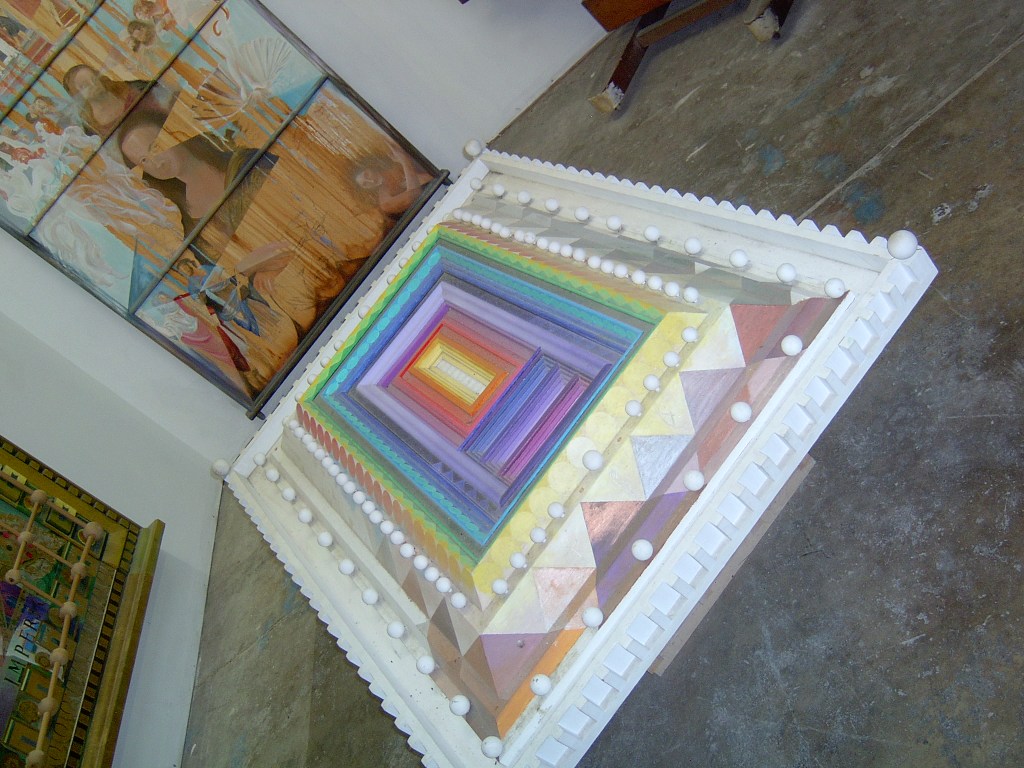
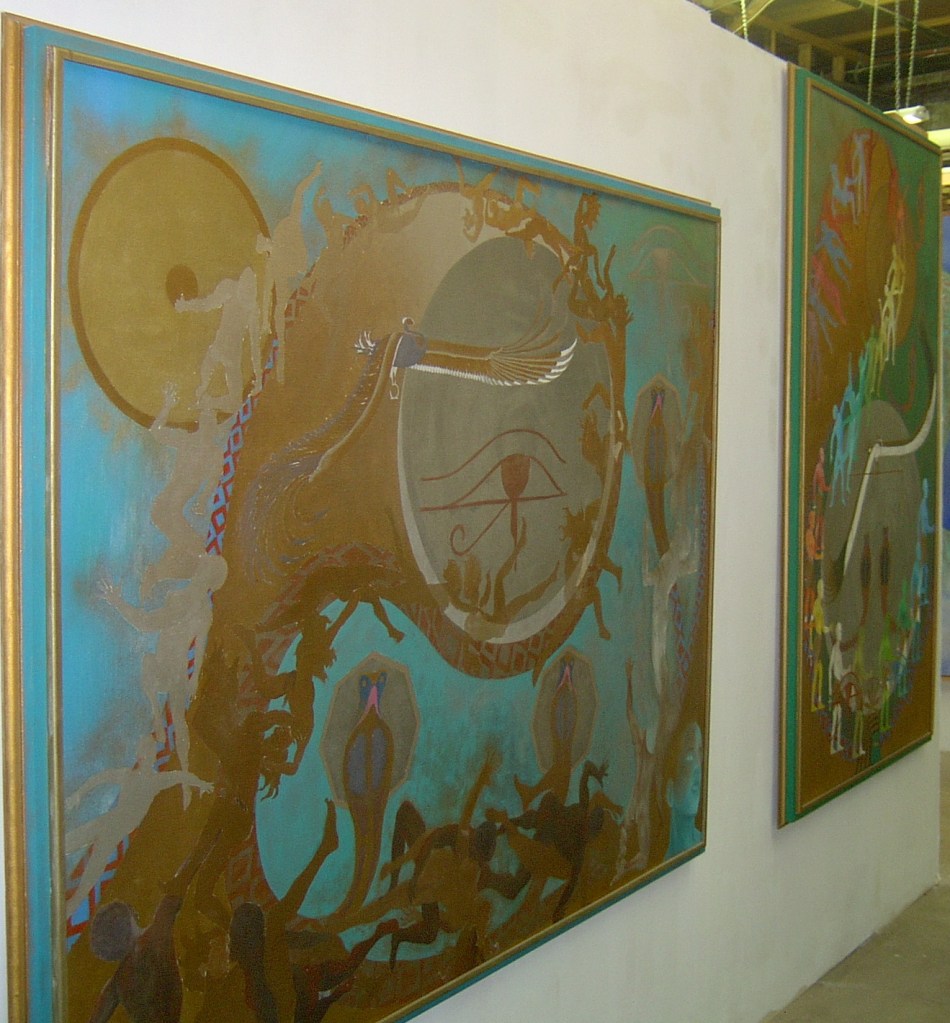
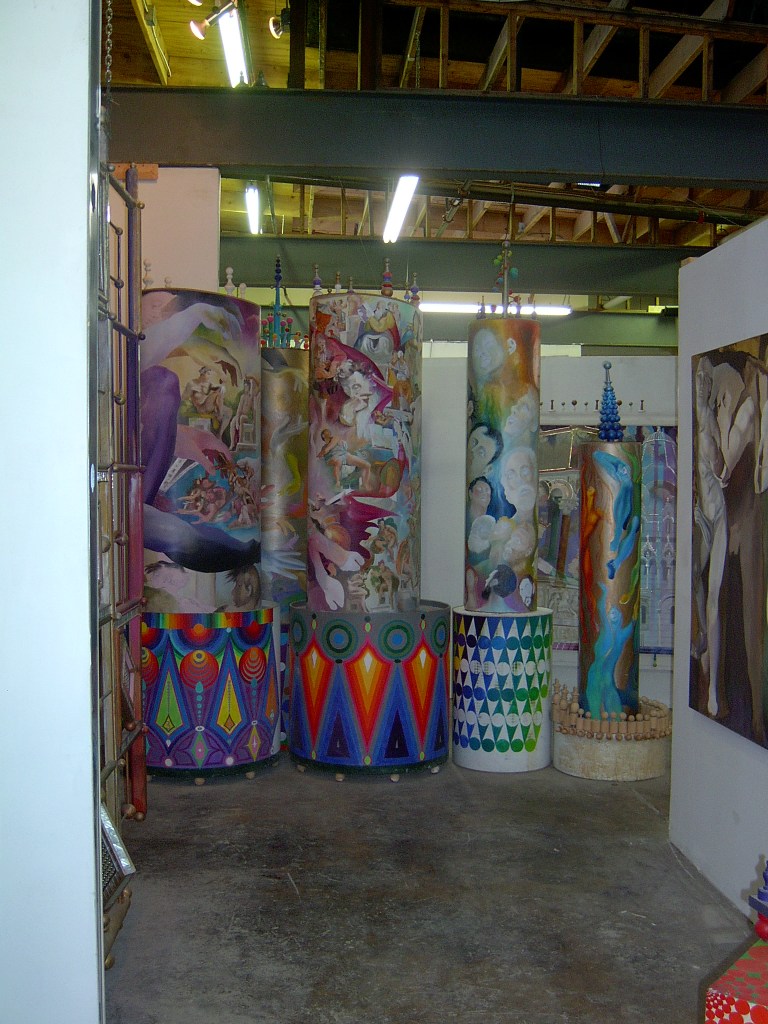
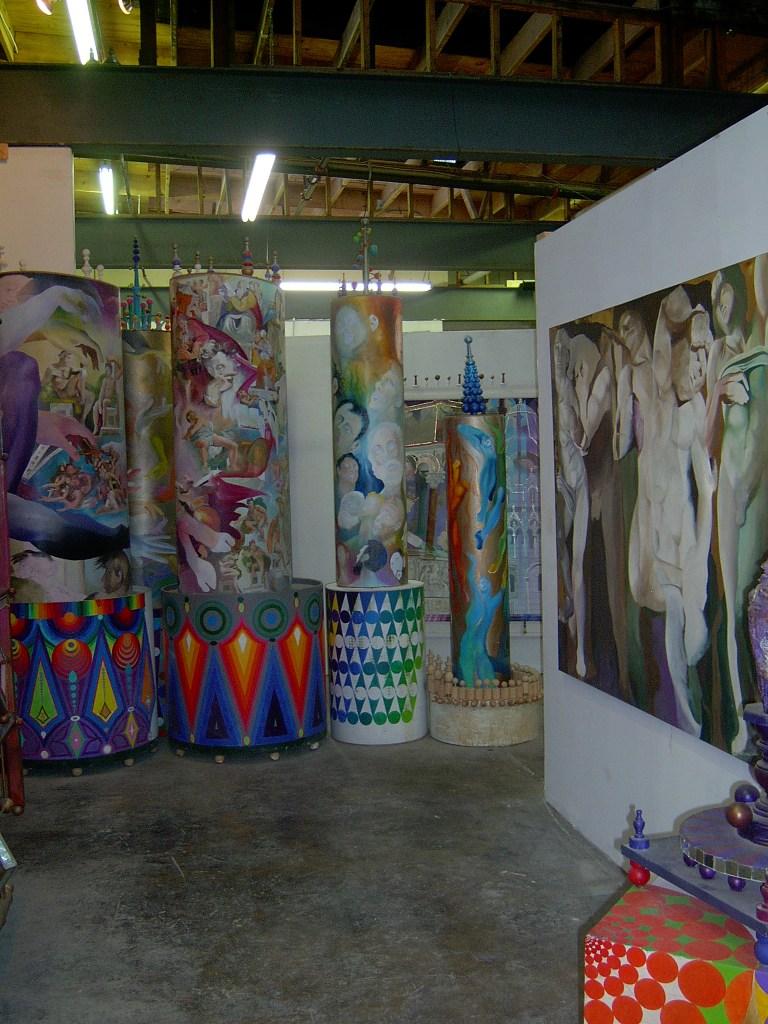
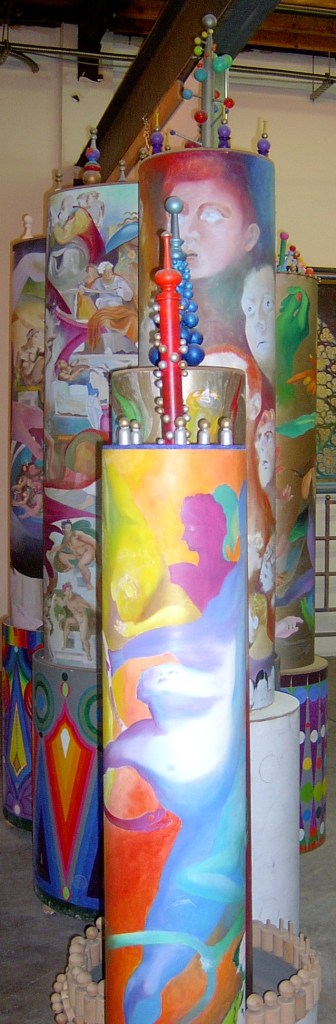
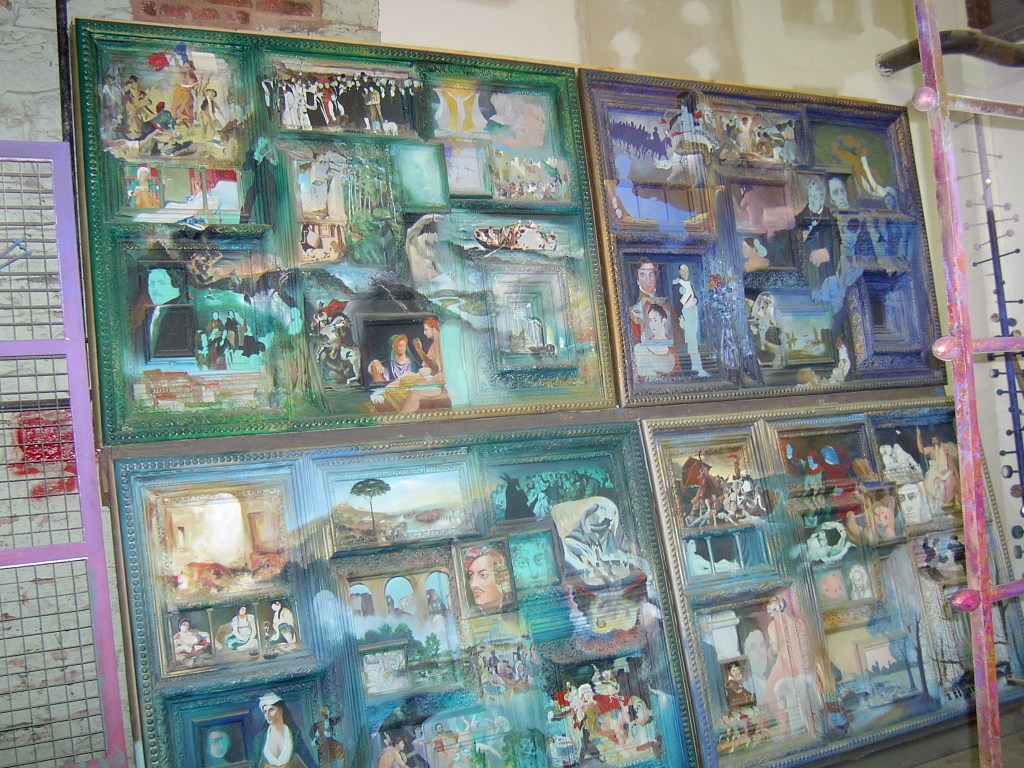
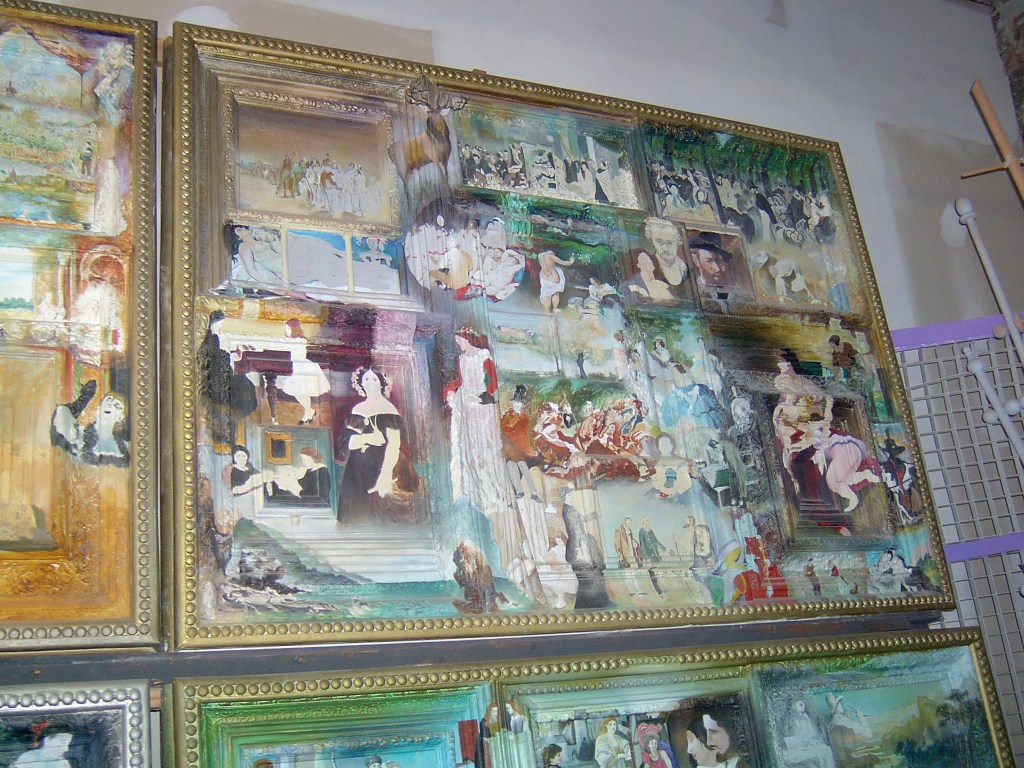
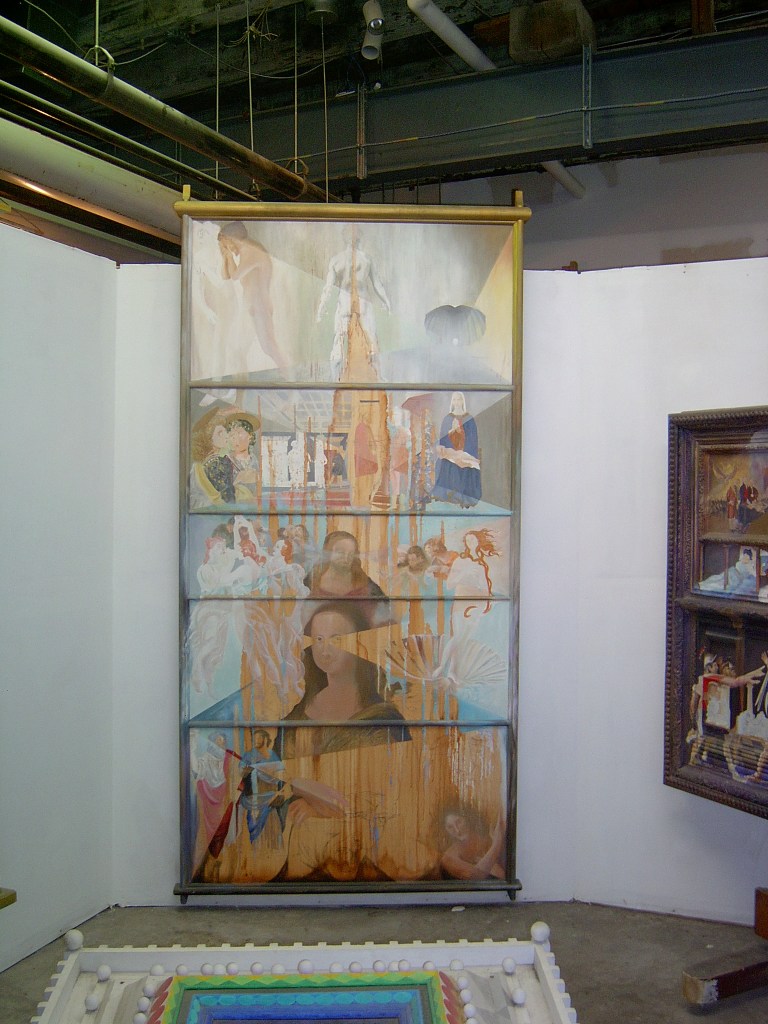
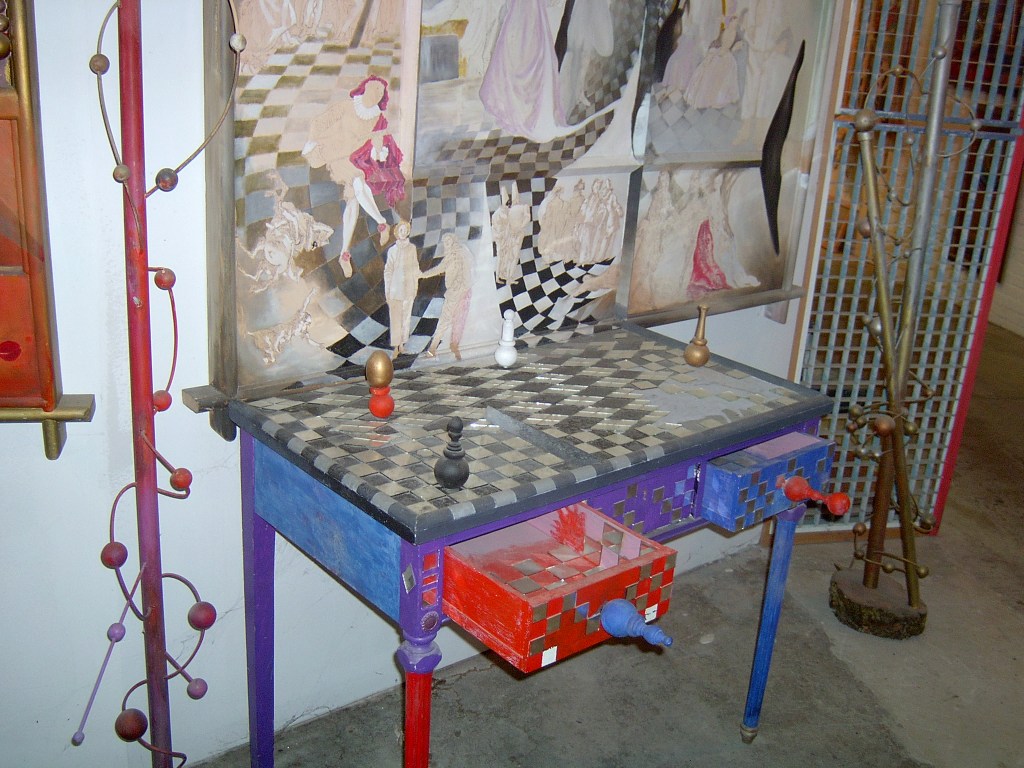
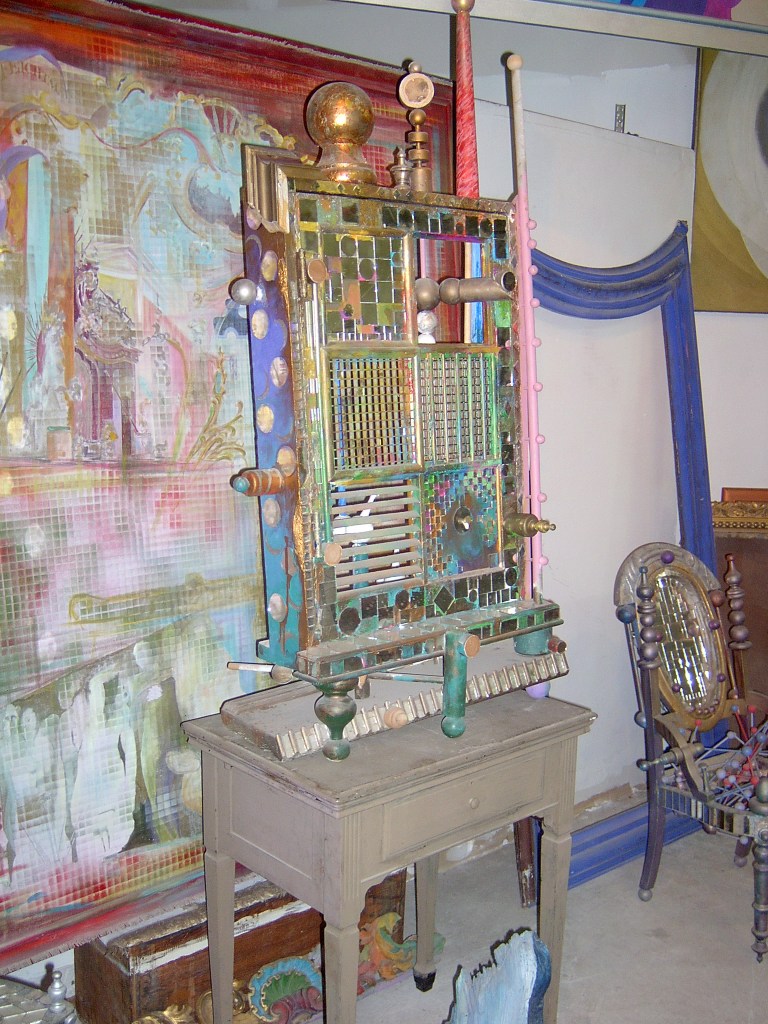
Upon arriving at the gallery and shaking off the rain and November chill, I met his daughter Heather, who was there to greet me. She informed me that Les and his wife, Sally, were going to be late because they were having car problems and were waiting on Triple A. This gave me the opportunity to talk to Heather and browse the art in the Labyrinth at the Amaranthine Gallery. The rain was a welcoming sound in the warehouse as it ran down the industrial tubing, sounding similar to a waterfall and exactly what I would expect while looking at Les’ work— spiritual and calming. I had looked up Amaranth before I went to the gallery and found out that it is a flower known for never withering, which I found to be a welcome metaphor for Les’ work as I explored his vast labyrinth. Heather was easy to talk to and we immediately engaged in an effortless conversation. She was my age with a shock of grey hair and an affable smile. I quickly found out that she was the middle child—all of them named after greenery: Holly, Heather, and Laurel. We laughed at my observation. I asked her about her father’s artistic process, and she informed me–as if she read my mind–that his process was just as important as the art itself. I expected to hear this. She also told me that he doesn’t think art is art without frames. I noticed this immediately when I saw how he incorporated frames into his art – sometimes they are merely an extension of the canvas as if it has spilled out onto the frame organically. Some canvases are created with frames attached. The three-dimensional aspect of it is intriguing. I have always loved art that moves beyond two dimensions. As we continued through the display, I also admired his kinetic sculptures. They were cylindrical designs of various sizes that stood in the middle of his modern art display. His use of color is vibrant—cool blues and violet mixed with warm reds and vermillion. He uses some original design, somewhat stylized, but interesting and eye-catching to say the least. He has one particular painting that incorporates a desk that extends from the canvas out into three-dimensional space. The design is carried from the vertical wall to the horizontal desktop and then to the open drawers. There were moments when I felt like I had fallen down the rabbit hole. What a lovely way to escape the world for an afternoon.
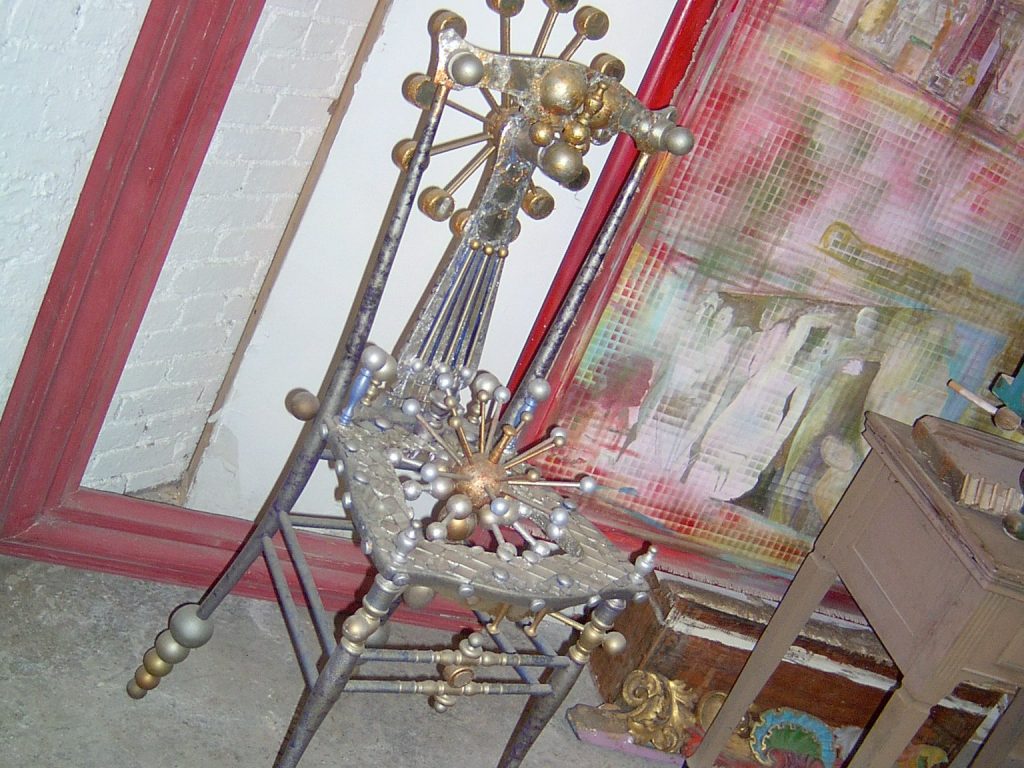
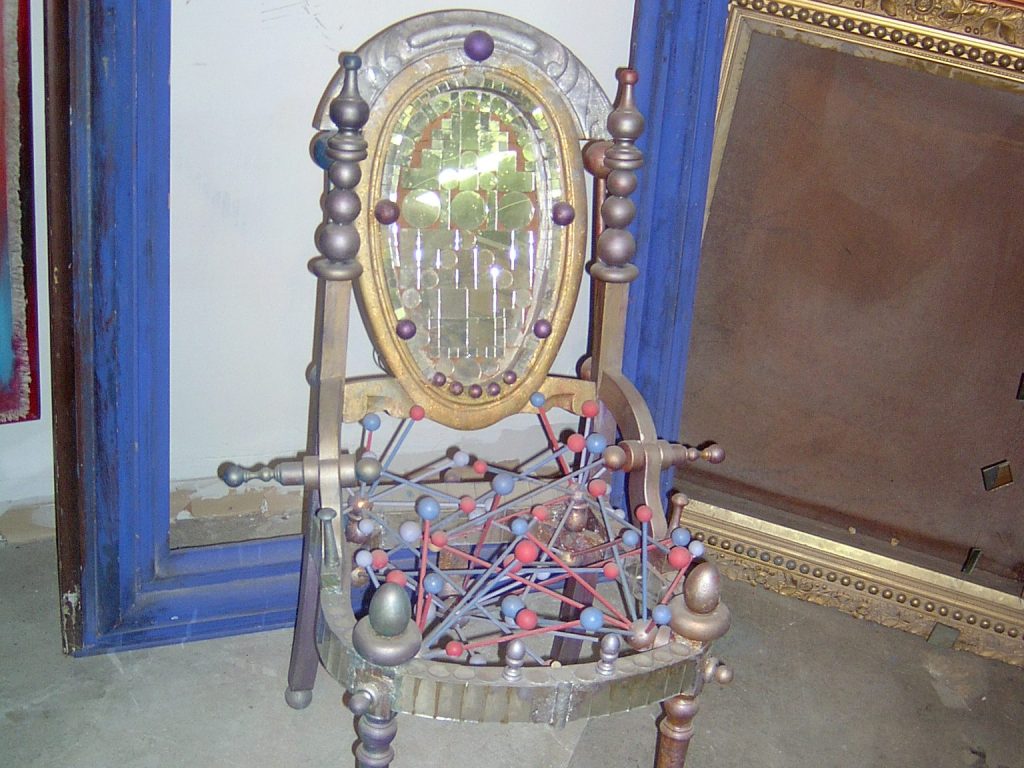
I noticed his fascination with chairs, which were equipped with miniature solar systems instead of seats. One Baroque painting had a doll extending from it dressed like an angel – the same angel in the painting. Another one had mop heads, and a broom integrated into it, and if I had given it a cursory look, I would have probably missed them. These are just a few of the aspects that make him a visionary artist: the objects he used to transcend the modern world and the way he uses them. Interestingly, most of his art is about other artists’ works, which is daring and humbling. He covers the history of art in many ways— the only thing I didn’t see was imitations of cave paintings at Lascaux. His work stops at modern art essentially, not really venturing into postmodernism.
Les had been making art, using artists as his subject for over 25 years and nothing had stopped him until that point. At 84, Les was slowing down due to his macular degeneration, a disease which slowly robs its victim of sight in an insidious way. Objects, which were once brilliant, become unclear, shadowy, and colors become indistinguishable from each other—at least those of the same intensity on the same end of the color spectrum do. Orange looks pink or blue looks violet. Along with these symptoms, Les had lost the ability to see fine details or to recognize faces. I cannot imagine anything more devastating to an artist. Heather showed me a machine he used to work on his novel, another artistic endeavor and one that was also inhibited by his vision loss. The machine magnified letters hundreds of times so that Les could see to write. The process was painstaking for him, but he had continued to work on his book, probably because he could not paint any longer.
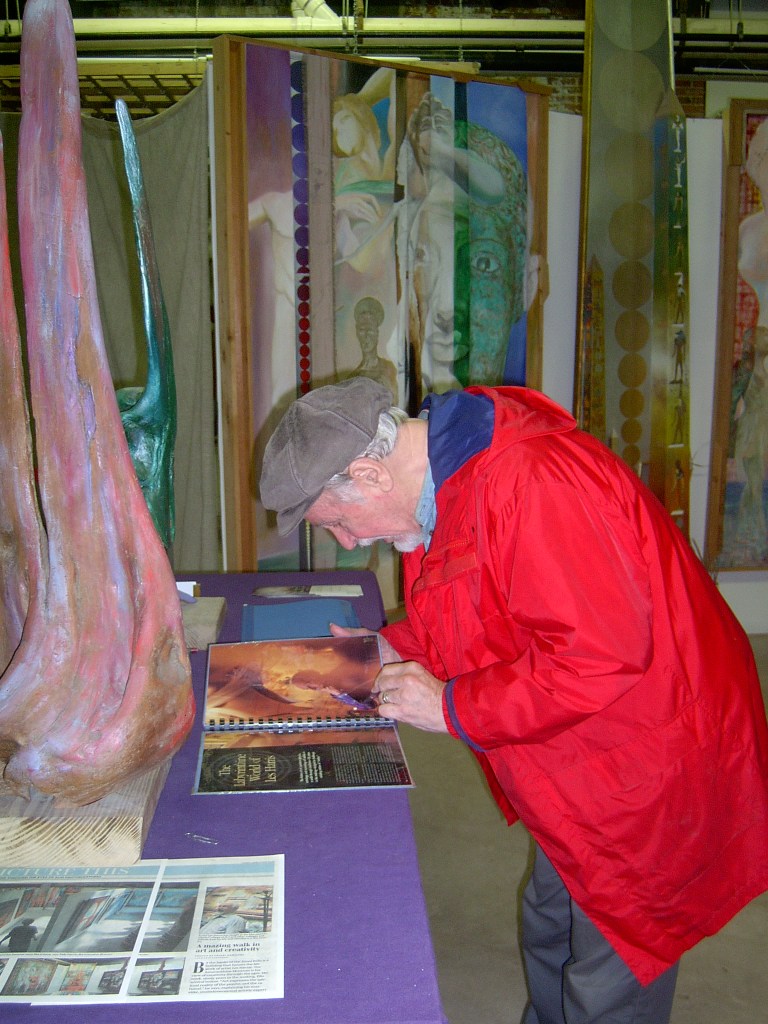
When Les finally made it (the tow truck dropped him off), the first thing he said was, “You have to excuse me. I’m blind.”
Heather said, “Oh, Dad, that’s not true. You can still see some.” I could see her intent was to keep him positive and focused on his work rather than his failing health.
Ironically, it wasn’t the macular degeneration that caused Les to stop painting; depression did. After being in the People and Hunt building, called the Studio Gallery and then later the Labyrinth at Amaranthine for 25 years, he was forced to move when the Clipper Mill renovations began in 2005. Besides costing him $10,000, the move caused him to sink into a depression that was with him until his death. He was extremely attached to his work the way it was situated, the way it was presented, the way it stood in the building it had been in for all those years. Having to change all of that after 25 years was disconcerting to him to say the least—it had caused his composition to be skewed. Compounded even further by the move and his macular degeneration, Les was also losing his memories. He didn’t even remember painting some of his most precious pieces. Not only was he robbed of his site to continue creating but his memory of what he had created was taken from him as well.
I could tell that he was highly intelligent and had information which was beyond my understanding. He would say things like, “the first male was female,” which I understood, and “the first Greeks were Jews, which I wasn’t so sure about” and “I am a 666,” in reference to his birth on June 15, 1923. In numerology, each part of his birthday became part of the 6: June is the sixth month, the 15 becomes six by adding one plus five; the 19 becomes ten and the 23 becomes five and when added it becomes 15, which in turn is adds up to six. We then acknowledged being fellow Geminis. In fact, his birthday is the day after mine and the day before my grandmother’s. Our other connection was that he used to lecture at Villa Julie College (now Stevenson University) where I also taught. He enjoyed our confections, which he felt were cosmic in some way and he began to share more with me.
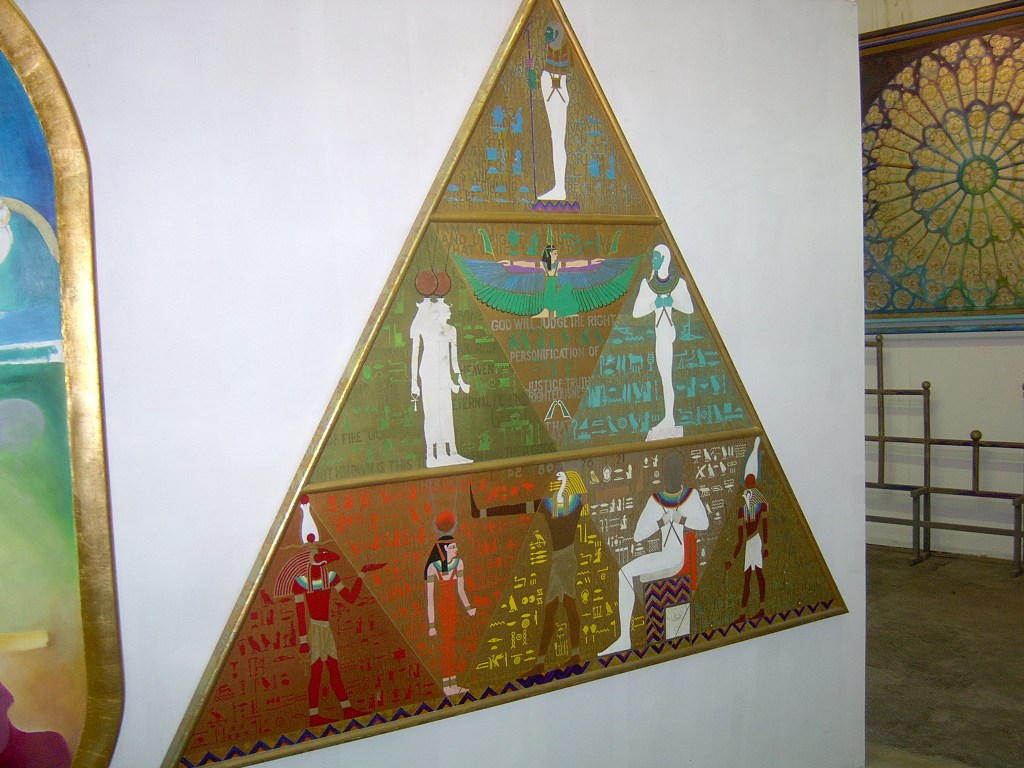
Les was a Christian Scientist. He placed much stock in numerology and spirituality as I do and so his proclivity towards these things made him even more endearing to me. Aside from his being an incredibly talented artist and an intelligent man, Les reminded me of my grandfather in some ways. He was kind and sensitive and had great rapport with his daughters – at least with Heather, and according to her, he was a great father to grow up with – a thing I admire for not having had one. He sat with me in the last room of the labyrinth and as I sat there, I was marveling at the Egyptian horoscope charts – the only thing he remembers painting. In fact, he claims that he is not talented or disciplined enough to have painted the works in the gallery but that people have assured him they are his. He made sure he painted what work was unfinished. I laughed because I told him I didn’t feel that anything was ever finished and that sometimes maybe they are not meant to be finished. I think he liked that assessment. I also suggested to him that maybe he was a vessel for some sort of message from the benevolent universe and he liked that idea as well. He said, “Yes, divine dissemination.” He struggled talking about his life’s works because of the myriads of things keeping him from it. He chased words like they were buses he was late catching. There were times when he had a hard time holding back the tears and I knew if he cried, I would cry, and so I hoped that he could manage so that I could too.
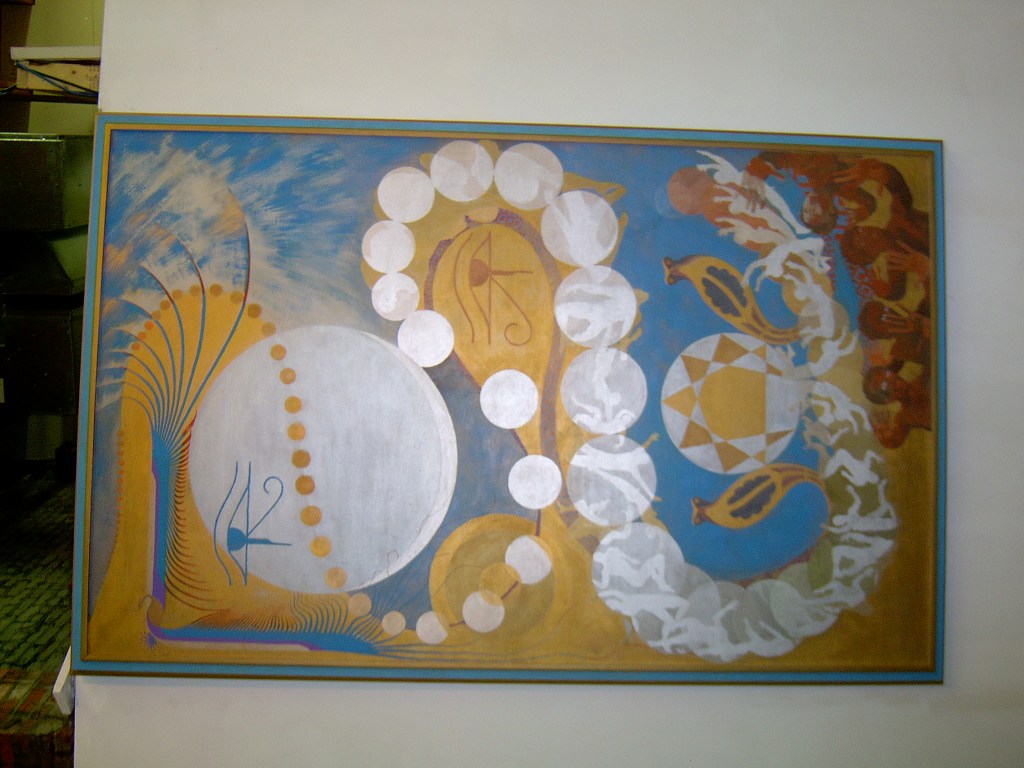
Then, I asked him about John Stewart Bell’s theories, which I am only familiar with because I read what I could about Les before meeting with him and he consistently referred to Bell’s theories in his former interviews. This changed the conversation from his not remembering to something he could latch onto.
One way of conceptualizing the world is the ART schema proposed by Immanuel Kant and others where ART stands for Appearance, Reality and Theory. Appearance is the facts of experience, both inner and outer, Reality is the hidden cause behind these Appearances, and Theory is the stories we tell one another about both Appearance and Reality. But Les uses Bell to discount Appearance, which I find amazing because it speaks to how he saw things. His view was completely not attached to what we would call reality. Now, I am not saying that I understood his ideas completely. His supposition of Bell’s that “reality is non-local,” is further complicated by his reinforcing it in his art. The crux is: none of this is observable! What complicated my grasping of “reality as non-local” is the idea that this reality is also free of gravity. Les said, “Man needs a god and a god is free of gravity.” I can apply this idea even further to his art by suggesting that it is also free of gravity – except as it intersects with his viewet at the moment we first view it. After that, it falls in with Bell’s theory. Les accepted that as a pretty good hypothesis, but I was really lost. I more of less just completely accepted his ideas as metaphysical explanations of the nature of life as we know it. I think in general, the whole theory is some sort of butterfly effect, where the butterfly flaps its wings on one side of the world and because of it, a tsunami rages on the other side of the world.
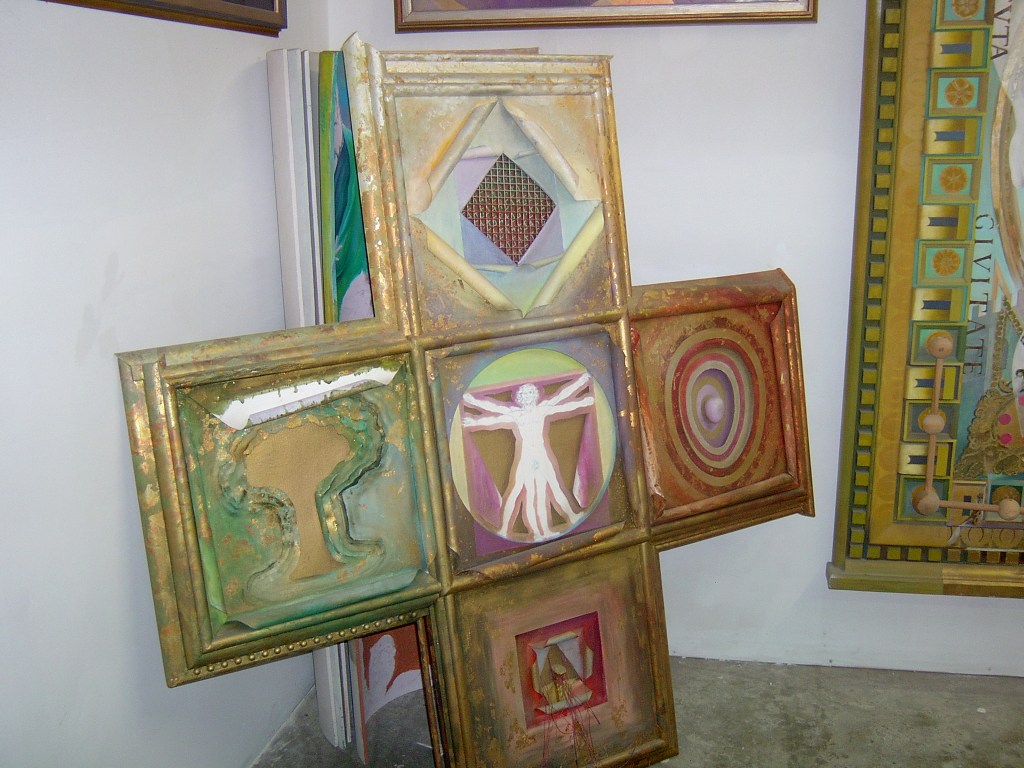
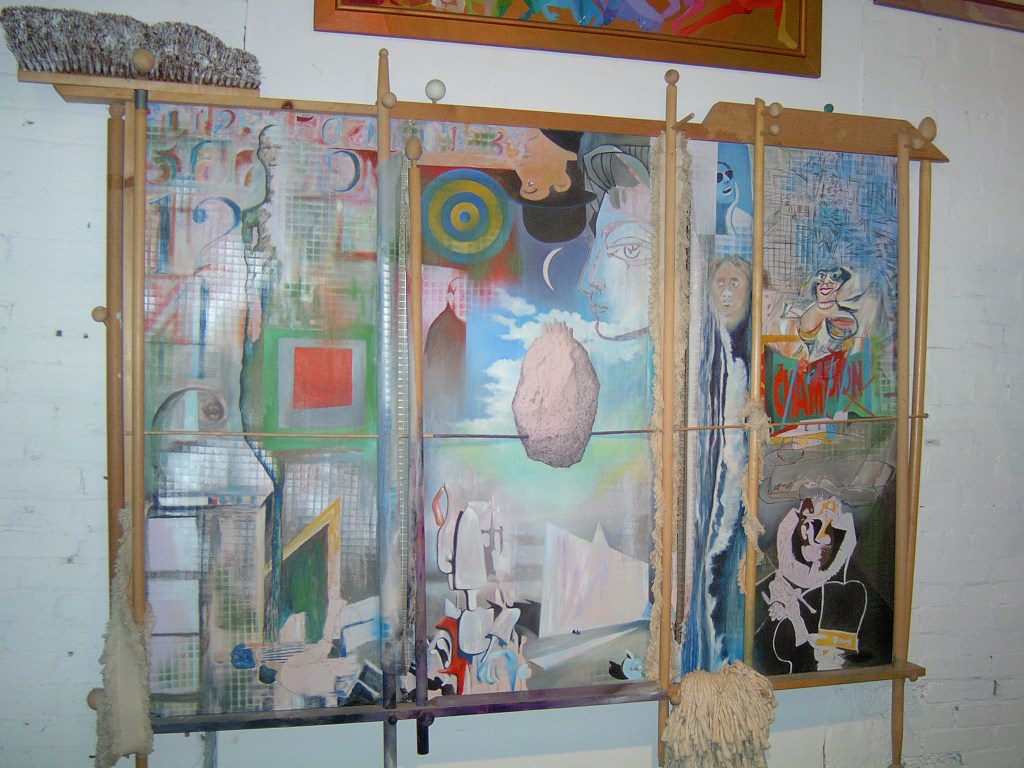
When I asked Les about his creative impulses and where they started from, he was clear that other art inspired him. He projects mythology and history onto art and that becomes part of his mythos in his creative process. There were times when words left him. He had to grasp for them and sometimes they came; often they escaped him completely; occasionally I managed to utter the correct one to help him along. The loss of his words brought tears to his eyes and then to mine. I could not help but think about how much of a theft this is to his sense of humanity. When we talked about his creative process, he said that nearly all his work was done between 10 pm and 2 am. I could relate to that because that is usually when I am the most creative. I think something exists in the universe at that time—something that is unquantifiable and unequivocal – just like Bell’s theory. Once again, Les exclaimed that he did not remember painting most of his works. He only remembered the Egyptian charts. He then went on to admire some of them, especially his craftsmanship that was included in his framing and in his display: some of them were on rods he crafted beside the frames that became part of the art itself. And then, he told me the story of a student, named Robert, who he taught at the Park School when he was faculty there. Robert was dying of aids. Les painted him into a particularly interesting painting that has a male figure tumbling through it. In order to accomplish this feat, Robert posed for him in a room with many mattresses on the floor. Robert then tumbled across them while Les captured those movements. Les felt that Robert was then immortalized in his painting—captured in his gravity defying leaps across the canvas. Robert had already passed.
We moved on then to the conversation about his book. He had been working on it for years. Dwellers on the Thirteenth Floor was to be his opus but working around his macular degeneration, painstakingly using this special magnifying machine to create the words he needed to finish the book when he could manage to pull them from his brain was exhausting. I asked him where he was in his work on the book and he exclaimed, the fourth floor. He made me laugh out loud. He liked it that he made me laugh and then he laughed. He attempted to explain what the book was about and again, I was lost. It had to do with mythology involving Venus and Mercury. He saw it in his head but trying to get it from there to paper was the problem. I suppose a visual artist has a difficult time translating visual images into words, especially one who is losing his vision, his memory, and his words. This is a lesson to the rest of us to get it down before we forget. He said he dreams the idea behind his book and then he must re-write it for the waking mind. He then jokingly said that he went to bed drunk at 6 pm after two bottles of wine every night just so he could dream. He made me laugh, because he said it so seriously. Then he went on to school me in how to pronounce Stolichnaya (stuhLEECH-nah-yah), telling me that everyone had been saying it wrong for years.
I went prepared with more questions than I could ever ask, and I ended up leaving with more information than I could ever write about. We ended on my butchering how to say Stolichnaya and then he wanted me to see the new restaurant they were constructing next door. He said we weren’t allowed in there but if we crept in the back way, we could see it. And so like a couple of teenagers, we snuck into the restaurant with Les acting like no one could see him and perhaps that was because he couldn’t really see them! I was so thrilled at his willingness to continue his exploration despite his losses and as far as the human spirit goes, he has it bursting over—onto canvas, into words, and at the gallery.
Les died a few months later of undisclosed causes. Perhaps his need to dream his world became the reality he chose. His non-locality of place has truly become free of gravity where I am sure he resides on the thirteenth floor. His Amaranthine Gallery indeed remains at http://amaranthinemuseum.org/
 Tug Hill Artist Network
Leave a comment