
What does former Led Zeppelin bassist John Paul Jones, jazz aficionado Béla Fleck, Mandarin lyrics to old-time music, and the first Official U.S. Cultural Mission to tour Tibet have in common? Abigail Washburn and Sparrow Quartet! This eclectic act debuted its new CD while ushering in the inaugural Delfest at Cumberland Fairgrounds Memorial Day weekend.
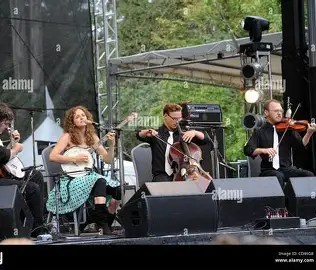
While billed as Abigail Washburn and Sparrow Quartet, it is interesting to note that sitting behind the bluegrass banjo is Béla Fleck of the Flecktones, whose name alone can generate huge crowds. Merging with Fleck is clawhammer banjoist and singer extraordinaire, Abigail Washburn, who can hold her own while sitting next to the great Fleck, which is no small feat as he continues to be one of the most innovative fusion artists in bluegrass. Fleck is known for his forays into uncharted musical territory, and the Sparrow Quartet is no exception, combining art and folk in a way that challenges, yet welcomes, the listener to take new directions. The banjo-heavy quartet is squared by strings–well, they are anything but square– with violinist Casey Driessen of the Duhks (from New York), themselves trailblazing musicians and songwriters, and cellist Ben Sollee (Turn on the Moon and Learning to Bend), whose style involves plucking strings and percussive bow techniques.
Washburn is touring this summer with the Sparrow Quartet on the heels of the release of her second, eponymously named CD. Both named Abigail Washburn and the Sparrow Quartet, which makes it difficult to refer to specific discography. The first, released in 2006 and the new one released in May of this year and produced by Fleck had more attention to the recording process than the first. In between these two Sparrow projects, twenty-eight-year-old Washburn was recording and touring with Uncle Earl—her other act.
Uncle Earl’s new CD, “Waterloo, Tennessee” (their second) and produced by John Paul Jones of Led Zeppelin fame, is a distinctive blend of multiple instrumentalist fusion bluegrass/old-time folkster females, each “ G’earl” with her own solo career like Washburn. It is rare that you find a versatile woman like Washburn who finds time to tour with two incredibly powerful acts, not to mention has time to release her own material. “Songs of a Traveling Daughter” (2005), her debut CD, was the result of deal that came to her after an extended stay in China. Her musical relationship with Béla Fleck began on this CD, which also included appearances by Ryan Hoyle of Collective Soul and Jordan McConnell of the Duhks.
A former law student, Washburn spent years living and studying in China, becoming fluent in Mandarin. She was back in the States at the International Bluegrass Music Association conference, sitting in the hallway jamming like all old-timers do when not performing and Nettwerk Music offered her a deal. Washburn felt particularly attached to old-time music after her return from China and was new to it as well as the banjo when she was offered a deal. Her love for the banjo stems from listening to North Carolina’s Doc Watson and becoming intrigued by his style. Her membership in the quartet is quite a feat when considering she is sitting next to Fleck, who has 35 years under his belt.

One thing Washburn has kept in common with all three acts is the use of her cultural connection to China. Her solo CD takes its name from an epic Chinese poem, which is really “Song of the Traveling Son.” The title song and “The Lost Lamb” Washburn sings in Mandarin. She has blended in traditional Mandarin dialect and sounds with her love of old-time mountain music. She says the blending captures her roots as a human being and as an international citizen, the resulting music is her exploration of what it means to feel intimately connected to two cultures at the same time. She does Mandarin old-time with Uncle Earl as well. Her song “Streak of Fat, Streak of Lean” with the G’earls turned into a kung fu clogging video (available for download on youtube), which won the Country Music Televisions Pure Twelve-Pack Award in April of this year. Washburn can be incredibly humorous as well as talented.
The pairing of Fleck and Washburn is unique enough since they are both banjoists, but when listening to Mandarin sung against a clawhammer banjo, a bluegrass banjo, a cello, and a fiddle , the Sparrow Quartets’ already unclassifiable music becomes even more so. They learned much of their material for the new CD when they were touring on the first U.S.-sponsored cultural mission to Tibet and China late last year, and so there are a couple of Chinese folk songs, a Cossack melody, some traditional tunes, as well as several Washburn songs, which she says, have been “sparrow-tized!”
Fleck is a long-time admirer of Washburn, calling her skills intuitive when it comes to music. The Sparrow Quartet is unconventional, says Fleck, and therefore, in line with his musical forte. He often feels that it is the four of them against the world when it comes to playing and sharing their music because there are so few bands doing what they are doing.
Fleck says that he and the other members created structures around Washburn’s songs – and these structures are first rate. They played two songs at Delfest influenced in this manner: “Kingding Qingge (Old-Timey Dance Party)” and “Taiyang Chulai.” Even though the crowd seemed a bit perplexed at first by the dichotomy of sounds, they responded with a standing ovation. In addition to the songs sung in Mandarin, Washburn sings “Great Big Wall in China.” While this song is not in Mandarin, it is nonetheless a song of her great attraction to the East. Another song from the new CD, “A Fuller Wine,” might go over as a top 40 song with the right marketing were it not so “sparrow-tized.” Another extraordinary twist found “Strange Things,” a traditional song done the Sparrow way, eerily sandwiched between “Overture,” featuring Washburn’s unique yodeling, and “Captain,” an incredible vocally savvy tune that especially reflects Washburn’s range and her ability to manipulate her voice—sultry and sweet at the same time. They played flawlessly except for Cary breaking every horsehair on his bow, as if only to prove how hard they played.
Like Washburn, Fleck is no different, having a busy schedule as well. Ever since hearing Earl Scruggs on the banjo and beginning lessons at 15 under the guidance of Tony Trischka, Fleck has continued his progression through all types of music with all types of musicians. Invited to play for New Grass Revival by Sam Bush at age 24, then he began a seventeen-year streak of playing with the Flecktones with Future Man (Roy Wooten) and Victor Wooten. He finds time to play with the Bluegrass Superstars, which encompasses the best of the best of all areas of music like Edgar Meyer, Yo-Yo Ma, David Grisman, and Jerry Douglas; and with TRIO featuring Jean-Luc Ponty and Stanley Clarke. In his spare time, he guests with acts like Phish and Dave Matthew. His newest CD is The Enchantment with Chick Corea (2007). Fleck has won 10 Grammies and with a total of 25 nominations, including spoken word. As further confirmation of Fleck’s success in expanding the relevance of the banjo, the nominations cover more categories than any other musician.
More recently, Fleck has become a cultural emissary like Washburn, having recently (2005) fronted the money and time to produce a documentary with his brother Sascha Paladino on the evolution of the African banjo. He wanted to see how the banjo in the modern world evolved in relation to its creation in Africa. He visited four African countries: Tanzania, Uganda, Gambia, and Mali where he traded songs, stories, and history with numerous people. The film, entitled Throw Down Your Heart was handed the people’s choice award “24 Beats per second” by SXSW Film Festival this year. The web site, throwdownyourheart.com, is interactive with some music from the film playing in the background. Fans are keeping their fingers crossed that a CD will soon come out as a companion to the documentary.
What will they do next? Given the nature of each member’s individual pursuits, anything is possible. Washburn’s roots are in African spiritual music, having sung with several black gospel choirs, so perhaps there is a documentary awaiting her too. Or perhaps a new pioneering Fleck-Washburn joint effort. For now, while Washburn will work on a new solo CD later this year, Fleck will be coming out with a holiday CD – remarkably, a genre he has yet to explore.
Sources
 Tug Hill Artist Network
Leave a comment