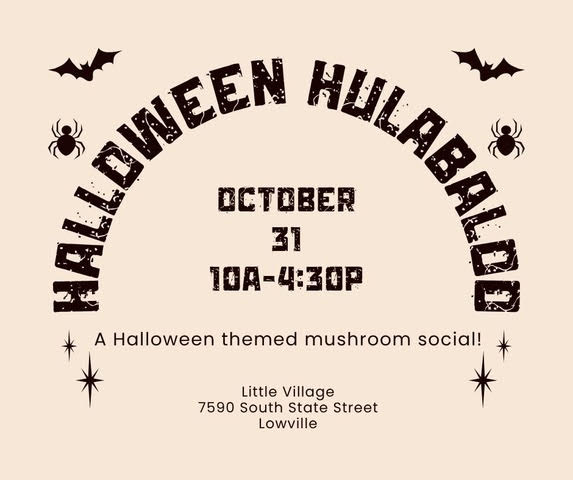
Oct 31, 10 am – 4:30 pm Join Little Village Mushrooms for a Halloween themed Mushroom Social!
Stop in and enjoy a free 8oz cups of mushroom tea. Three flavors of mushroom based herbal teas are available. Enjoy a free lunch snack in our decorated Halloween pop up space! Taste vegan tofu-mushroom and chicken Shiitake dumplings with dipping sauce.
Shop special deals on fresh mushrooms, mushroom products, books, and seasonal goodies. Enjoy promotional pricing on mushroom dumplings for your freezer and special event pricing on teas and fresh mushrooms. Shop a curated assortment of gently used mushroom themed books.
Snag your very own (free) copy of Yokel Magazine, volume 1 – a beautiful. new glossy arts zine conceived and designed by Rachel Grunert featuring local creatives. Lulu’s Cookies will be in the house with a variety of seasonal cookies–vegan options, too!
Stay a while… bring a sketchbook, journal, or book to read. Or stay for the Candle workshop:
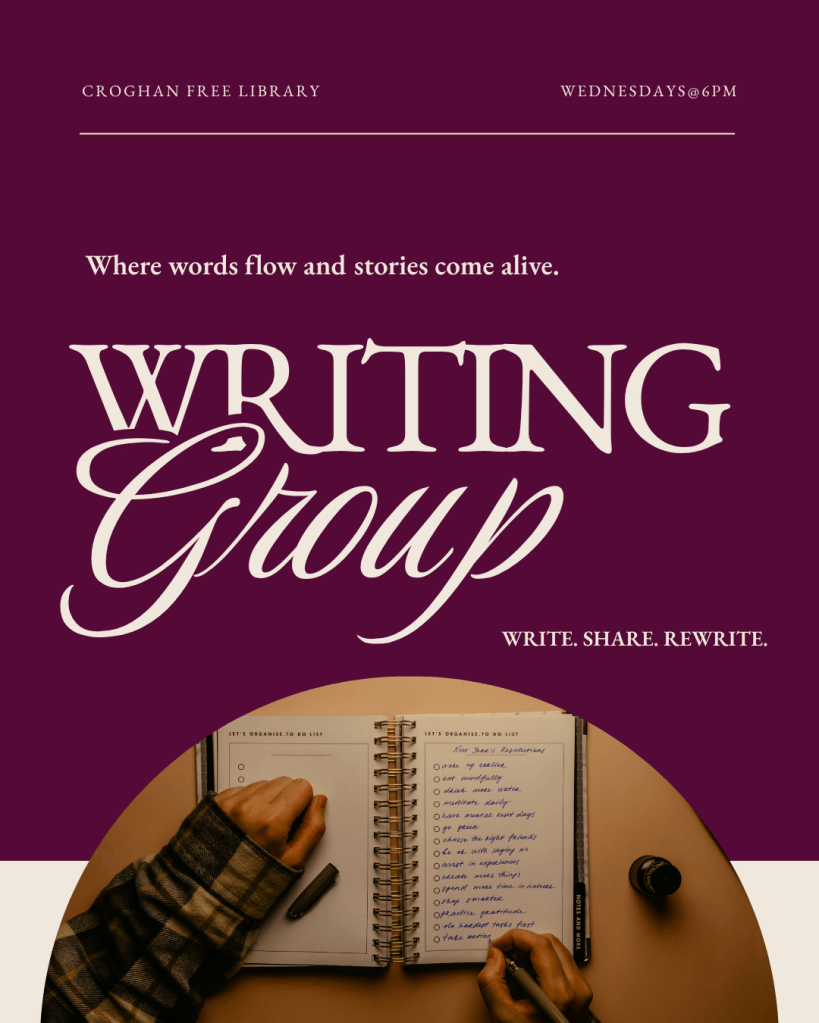
Writer’s group: Don’t forget the writing group that meets at Croghan Library on the first Wednesdays of the month. Please join any time but check with the library at Phone: 315-346-6521.
Poet Alesa Bernat, (Lowville, NY) is getting noticed—one could say she is on fire. Her recent activities include being part of the 2024 cohort of the Artist as Entrepreneur Program made possible by the New York Foundation for the Arts (NYFA), the New York State Council on the Arts (NYSCA), St. Lawrence County Arts Council (SLC Arts) and held at St. Lawrence University this past fall.
Alesa is also riding the wave of her debut poetry collection published last year, which takes the reader on her journey through the diagnosis, treatment, and adjustment of living with bipolar depression. Navigating bipolar depression and motherhood culminated in her first book of poems but it was not until she attended a lyrical poetry class at the Adirondack Center for Writing that her passion for writing and her work was renewed. Since then, she has been working on new material and is ready to share her work in public.
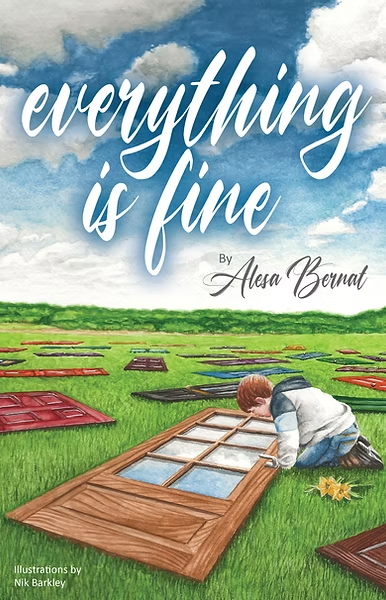
Her resurgence occurred, like the cicada of which she writes in “Elegy for Heartache Resurrected,” with her book of poetry, Everything is Fine. The title itself is telling for those who use the phrase when they are indeed not okay. Alesa’s book reveals the trials and tribulations of motherhood and mental health– an intersection where women are often not fine. It is an intersection most mothers have visited at one point in their lives. In addition to becoming a mother, Alesa was going through medicine changes, which can be debilitating in and of itself. Authoring her book helped her to work through some issues and now she feels ready to embrace her art by participating in competitions, submitting work, and scheduling readings.
In the last few months, Alesa’s creative life has grown with several other publications and events. Her poem, “Unsuitable Elements” was published in Boreal Zine, an ADK based online publication. Her poems , “When the Midsummer Comes, I Live as a Neuroptera,” was published in True North: Words and Images from New York’s North Country while “Elegy for Heartache Resurrected,” (see below) received an honorable mention in Seneca Park Zoo’s Water into Words Poetry Contest, an event co-sponsored by Writers and Books. Additionally, she was interviewed for Arts and Culture at Cardinal Points, SUNY Plattsburgh’s independent student newspaper and participated in the Adirondack Center for Writing’s 2024 Poem Village. She also participated in “Exploring Fall Island,” ecological history of Fall Island sponsored by NYSCA, where she read alongside other poets in the full exhibit.
Everything is Fine Summary/Review
Alesa’s approach is unique, being open about her struggles with bipolar depression. In fact, her poems are filled with duality – in that they are told honestly and with the perspective of both a much younger self and the nurturing mother she has become. Upon reading her book of poetry, the reader has the luxury of knowing that Alesa has come through her ordeal and is now successful: a mother of three young boys, a fulltime speech-language pathologist, and an owner of a small press. She lives with her husband on their family farm, participates in the community, and has a loving church community.
Sectionally, the book is broken into two: “Everything” is defined by 42 poems and “After Everything” has 38 poems. “Everything” examines the highs and lows of bipolar disorder with keen accuracy, while “After Everything” gives us a glimpse into the process of healing and unification—with herself, her depression, and her doubts.
In “Stay,” the reader learns her glittering world/dissipates in a minute” (line 22-23) and in “Haunted,” the ghost is her own reflection: “there is a mirror in my eyes/shattered glass and gold edging” (lines 1-2). Her mirror image becomes her other self, the one she distrusts. As anyone who struggles with bipolar knows, the mind questions everything, including one’s own worth as a person. She sees both the fractured self and the self that she wants to be – the one in gold. She explores this idea further in “Mirror, Mirror” a sustaining metaphor. This other self is the image she must integrate with to be whole. Yet,” her “soul has gloriously “Fallen Apart” (lines 6-7), which challenges her perceptions. Her “other” continues to sabotage her efforts by telling lies, and she is not able to decipher reality from illusion. Discriminating between truth and lies is an art itself when confronted with bipolar depression. In fact, this duality culminates in “Sandcastles where “not a single truth is in the grains” of sand (line 8) and with a lie that becomes personified in “Boast,” – which then grows a backbone and runs away . . .
In parallel imagery, the reader learns Alesa’s mother is “fire,” “burning boundaries to the ground/leaving bare mountains at her feet” (“Dance Moves,” lines 25-26), rising like a phoenix, whereas, her father is “ice,” “taking up more space than water” (“Dance Moves” 27-8). They are polar opposites. Later, Alesa also likens herself to a phoenix–burned and renewed–as “a sacred sign” and a “harbinger of catastrophe” (“Phoenix Rise,” lines 3-4). This duality itself is an example of bipolarity. She struggles with opposites on all ends and is seeking to find the path in the middle. The reader learns “There was not room for both of [them] in “Eden,” (line 10).
And in her “Sunshine Fading” Alesa manages to confront the lies perpetuated by her other, where “between us,” she says, “we built entire spheres. Planets devised from [our] deceptions” (Line 10). Here, she relegates her other self to the “Dark Matter” of space. She leaves the reader at the mirror image once again in her “Precipice” where she is attempting to gain balance. At that point, “Crashing” indicates the cyclic pattern she has become used to – where Alesa is forced to battle the monsters of her emotional roller coaster (“Songbird of jealousy”). She then names yet another obstacle to her wellness – mania. And in the delicate art of balancing motherhood, marriage, and her image of herself, she must learn to balance her highs and lows (“Mania, My Mistress”).
Through losing a child, a suicide attempt, and a stay in a mental facility, Alesa plunges the depths of darkness — where all are equal (“A Window by the Sea”). In fact, her full realization comes when she understands that she is not alone and that she is in the “The Most Spiritual Place” (the mental facility), where everyone is “stripped of everything worldly” and “at the bottom with [her]” (line 13).
This is where we leave her at the end of “Everything.”
In “After Everything,” Alesa is renewed, having grown both spiritually and emotionally. She has found “A Promise of Hope” that has “transcended [her] darkened line” (line 5). She finds solace in nature and in ‘Healing,“ learns “survival in salvation/redemption in harmony” (lines6-7). Through her journey of love, marriage, motherhood, and mental health, she has embraced herself with all her beauty and flaws (Masterpiece).
Learning to love herself proves to be one of the hardest tasks she is confronted with. In “Agape”” weighed down in flight/the bird persists toward its perch” (1-2) imbued with faith, its “Wings Touching [the] Sky” like an eagle cries “I am here” (6-7). At this point, she can speak with honesty and is deemed worthy over and over (lines 13). The self finds beauty in truth (“Healing”), which leads to courage that takes the form of a sailboat, so she must learn to sail.
Alesa is, in effect, learning to fly, referring to the bird imagery throughout—but sailing works well since we know the sea is not always calm. Like her mother, Alesa has learned to build herself up from the ashes of her past to create something beautiful, like the phoenix. From here, her journey is a spiritual one. She learns to “Lead Her Depression on a Leash” because it is a mean dog she has had to train. She leads her mean dog on a path “Out of Darkness” where it creeps away to the shadows (line 14). And she can honestly say that everything is fine.
The last healing poem encapsulates the cover art of derived from a photo she took of her son, “Doors in the Earth.” The art depicts her son looking into a glass door framed with eight windows that all reflect the sky. Alesa is freed by the mirror image of her reflected in her son – and he is the one who opens the door for her.
With the attention Alesa is receiving, it is safe to say that everything is fine.


 Tug Hill Artist Network