Art and Healing: Building Community Through Creativity by Kelley Martin


When I first moved to 40-acres in the Adirondack Park during the height of COVID, I was driving an hour and a half to teach in a mask at Utica College. Driving never bothered me but teaching in a mask was enough to make me want to retire early.

I thought it ironic that Utica is where I started teaching English full-time 20 years ago and it is where I stopped teaching last year. Before I taught, I was in nonprofit arts and humanities organizations: I was director of a small press, a professional dance company, as well as program director for an arts center, a traditional arts organization, and a humanities center in North Carolina and West Virginia. I have run festivals and presented artists in all of them.
This image has an empty alt attribute; its file name is arden-a.-sherman2.jpg
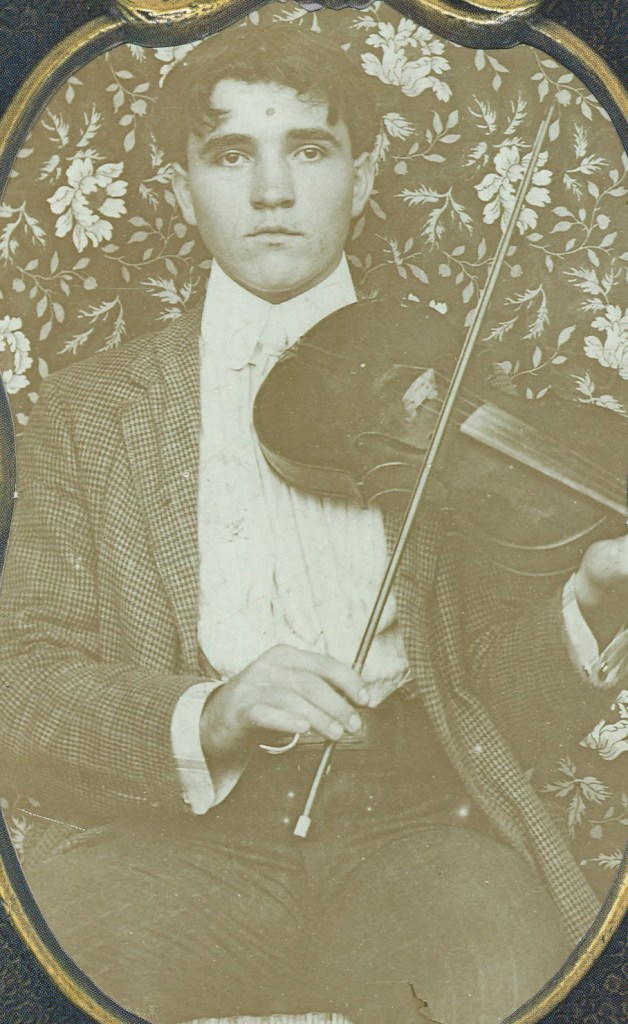
Fiddlemaker Arden Aldine Sherman from Parsons, WV, 1886-1962

Art has always been part of who I am. My great grandfather was a fiddlemaker in West Virginia and one of the first students accepted to Julliard. My grandmother sang (loud and off key but she sang) and made beautiful quilts. My father played the guitar. My mother says I carried my “record player” with me everywhere I went ever since I was three-years-old. But other than having a good ear, I am not a musician. I tried piano and clawhammer banjo, failing miserably at both! I also tried modern dance, theater, and journalism in my search for the perfect art for me. I settled on writing. I dabble in other areas but focus on writing. I have published a book and other material, but none of this was accomplished without the help and support of my writing and art communities.

Coming from West Virginia, I am familiar with rural life, but I have also lived and worked in large cities. I prefer country life but gaining access to arts and folks who love the arts is not easy when there is at least an hour’s drive to get to events. I want to write but do not have a group of readers and writers for inspiration and motivation.
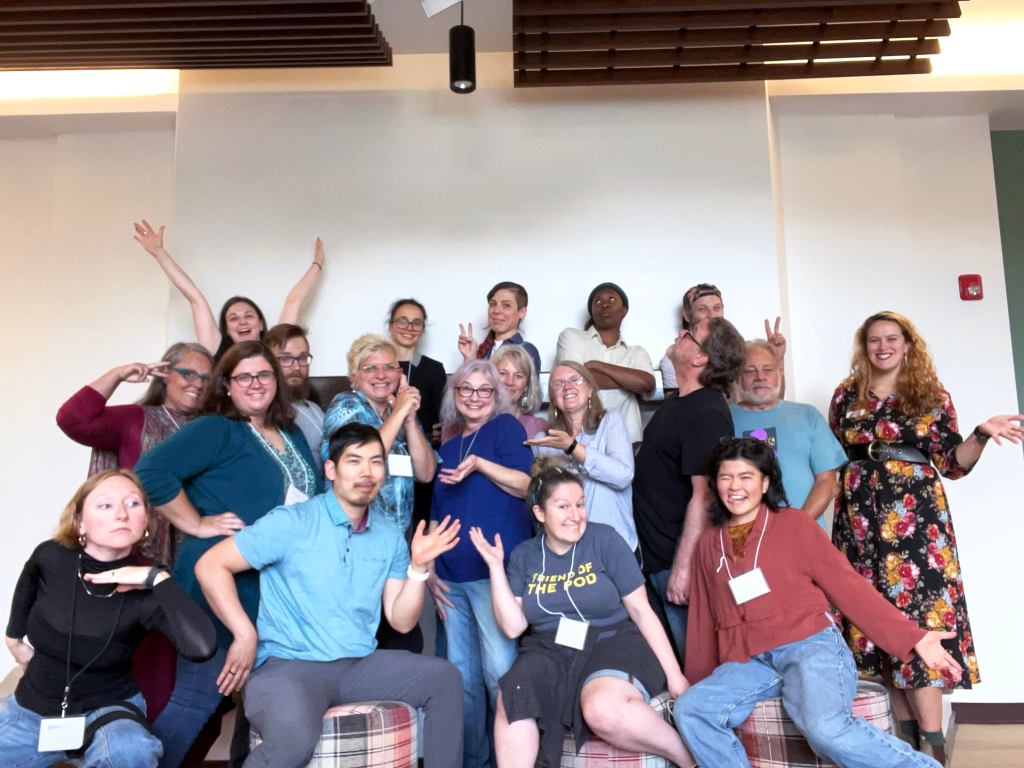
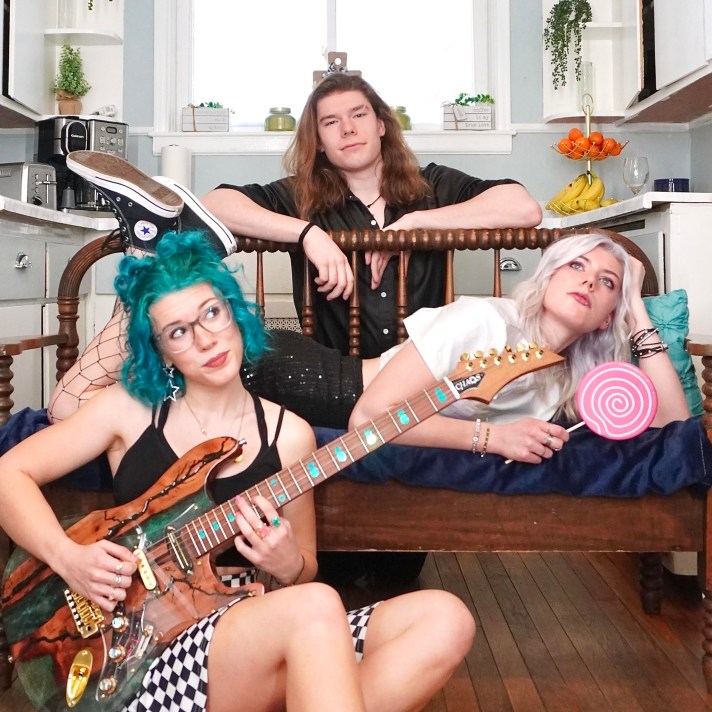
Image of young man with fiddle
Photo by SLCArts Artists as Entrepreneurs (2024).
I’m in the middle looking confused.

When the St. Lawrence Arts Council announced the Artists as Entrepreneurs program, I applied, thinking it would help me share my ideas. It was this fellowship that gave me the opportunity to connect with and learn about artists in the region. Once I gained the “permission” from my peers to embark on this journey, I felt motivated again.

In my four years here, I have spoken to numerous local artists and crafters where I learned what some of the major hurdles are in displaying art, having events, and access to classes and workshops. My mission is to find out who and what in the area promotes the arts and who wants to be promoted. I am hoping that helping one another and starting a community where artists and their audiences can connect will enrich everyone. Some ideas like an artist map and listings, event listings, craft fair listings, performance venues, etc, would help our artists.

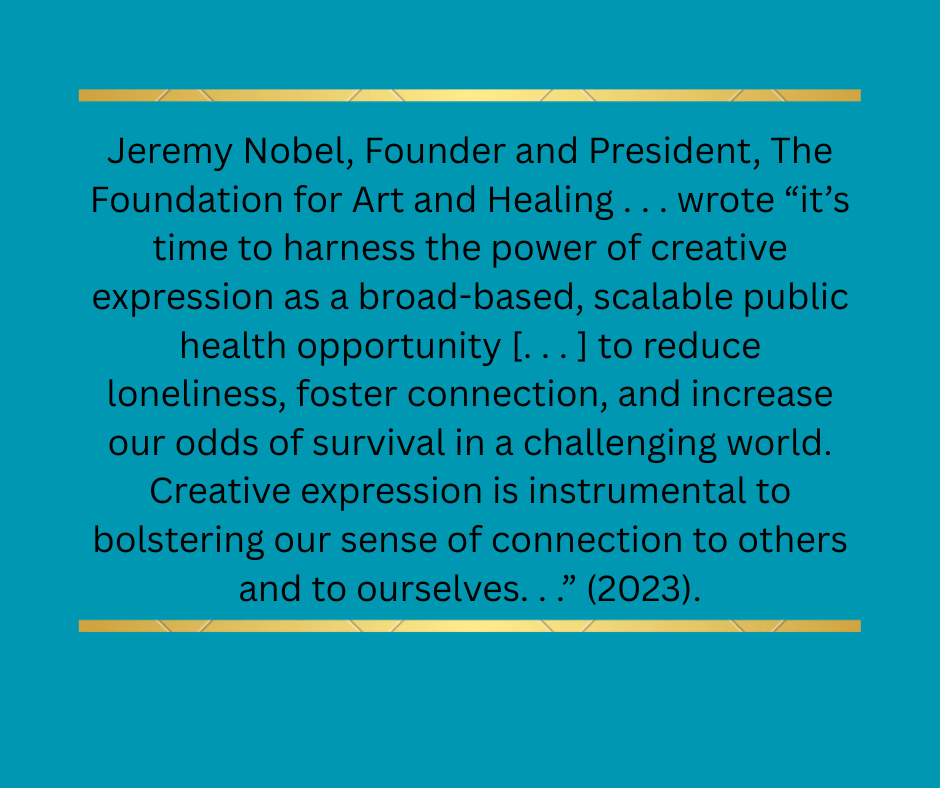
My search has just begun, and I will share what I find with this group. What I have learned is that many of us in the arts community experienced profound loneliness during COVID. Loneliness was already high when COVID came along and made loneliness an epidemic. Artists are greatly affected because they rely on their audience—if they have no audience for feedback, they are hindered unless they find another way of interacting with people. Many were creative during COVID and found unique ways of collaborating digitally! But some, like me, yearned to see a smiling face or to hear someone read a poem out loud or play a folk song on the guitar.
This image has an empty alt attribute; its file name is jeremy-nobel-founder-and-president-the-foundation-for-art-and-healing-.-.-.-wrote-its-time-to-harness-the-power-of-creative-expression-as-a-broad-based-scalable-public-health-opportunity.png

Art is healing. Art gives people the opportunity to interact in a way that is less verbal and less confrontational, something that is needed in today’s world. It allows us to see many perspectives on the human condition. It is a universal language that transcends cultural boundaries, facilitating communication and fostering understanding between diverse groups. Engaging with various artistic expressions not only deepens empathy but also broadens people’s worldviews, ultimately fueling creativity and innovation for artists. Simply put, it is a win-win for everyone.

Thinking creatively is not limited to one type of art. Creating is healing. Creating with others is unifying. Working together toward a common goal in art is affirming of who we are as artists and individuals. And, all art is needed now more than ever. Tug Hill Artists Network (THAN) does not discriminate when it comes to art–all art is appreciated, from recycled art to Art Nouveau, from folk to fine arts, from rap to classical music, from clogging to ballet, and from Shakespeare to improv.

To that end, I am asking poets, dancers, storytellers, musicians, all artists please share your work to the Facebook Page (it is your page too). The page is meant to share arts in the area. Share your events or other events. Share your work in progress or your finished pieces. Invite conversations. Also, if you want to be interviewed or know someone who does, email me and we can talk about it. Sharing our stories is imperative to community. Audience members share as well! What do you want to see? All you must do is follow the page first to share an item onto it.

My next request is for you to fill out this art survey so that we can, as a community, start to make some plans for classes, workshops, and events. Once we get an idea of who is interested and in what, we can decide on next steps. There is no cost or fee. This is done out of passion for art and community. We can seek funding later for any ideas. We plan on having an in-person meeting this summer sometime for those who can meet.

In the coming weeks, you will hear more about me and others who are interested in the same thing – working together rather THAN alone.

Kelley’s Bio and samples are here

Reviving Community Spirit: North Country Talent Show, featuring Undefeated

Lowville Town Hall Theatre

April 24; 6-8pm FREE


Unlike Tom Hanno, Simon Cowell doesn’t think the North Country’s got talent. When Tom first conceived of a talent showcase, he named the event and the associated webpage North Country’s got Talent, thinking it timely and relevant! However, he was soon sent a cease-and-desist letter from America’s got Talent.  Despite this naming issue, Tom persisted. For now, he is simply calling it the North Country Talent Show. To create a more characteristic name for the show, Tom has started a contest to rename the event in a way that represents the North Country. An announcement will be made later in this regard.

Tom’s idea began long ago to showcase talent, but then a serious life event delayed his vision. This life-changing event, in Tom’s view, was a blessing in disguise because it forced him to reflect on many aspects of his life. What he realized was that he was isolating himself and that he was not a happy person.  So, he set about changing things. He realized he needed to improve the way he felt and to put his energy into something creative. As a musician, poet, and writer himself, he focused on creative aspects: He joined a band and resurrected his plan for the North Country Talent Show.

When Lowville Town Hall Theatre offered to sponsor the show, Tom could not resist the start of something he felt could be a traditional event for Lowville. Hoping to bring out creative people who otherwise would not have a way to showcase their talents, Tom’s additional hope is to provide a sense of community that most people have lacked since COVID.

Tom considers the talent show as the start of his legacy, so to speak, to start something that can exist in the future with a positive effect on the community and its people. “Art without division is needed,” he said, to combat the politics of today that bleed into our daily lives. Art, he says, “speaks it own language.” Not to mention that consuming art and music as a group affirms our sense of community, which is a proven scientific fact! Tom elaborates, “There is no division because we are united by expression” when we are part of a creative act—either as performer or audience member!  

While the slate for this year’s show is filled, Tom is seeking acts such as comedians, vocalists, mimes, one man bands, magicians, puppets, dramatic monologues, tattoo artists, music, poetry, ventrilaquists, dance, demonstrations, or any family friendly act for next year! Judges so far are Tanya Roy with The Butler Did It Players, Frank Hirschey, and Mike Avery. Performers will be judged on professionalism, ability, creativity, material, among other criteria. Prizes for first and second place are a mixture of cash and merchandise like tickets to the Lewis County Renaissance Fair August 30-31 at Lowville Fair Grounds.

Jess Boliver is also helping Tom with the show. Lined up so far are Sean Corbitt music, singer-songwriter and multi-instrumentalist, a dancer, a musical duo, Allison Fleming and Jason Griffin, and more with a closing performance by rock band sensation, Undefeated. Aside from performers, vendors Jody Baughman from KneatlyKnotted and Kayla Noftsier will be selling their jewelry.

To find out more about sponsoring the event, contact Tom.

Everything is Fine: Alesa Bernat’s Powerful Debut Poetry Collection

Poet Alesa Bernat, (Lowville, NY) is getting noticed—one could say she is on fire. Her recent activities include being part of the 2024 cohort of the Artist as Entrepreneur Program made possible by the New York Foundation for the Arts (NYFA), the New York State Council on the Arts (NYSCA), St. Lawrence County Arts Council (SLC Arts) and held at St. Lawrence University this past fall.

Alesa is also riding the wave of her debut poetry collection published last year, which takes the reader on her journey through the diagnosis, treatment, and adjustment of living with bipolar depression. Navigating bipolar depression and motherhood culminated in her first book of poems but it was not until she attended a lyrical poetry class at the Adirondack Center for Writing that her passion for writing and her work was renewed. Since then, she has been working on new material and is ready to share her work in public.

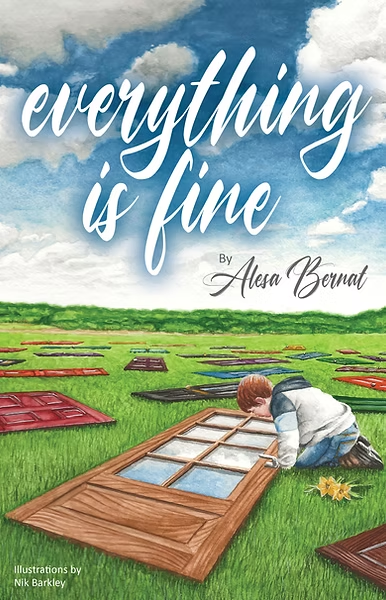
Her resurgence occurred, like the cicada of which she writes in “Elegy for Heartache Resurrected,” with her book of poetry, Everything is Fine. The title itself is telling for those who use the phrase when they are indeed not okay. Alesa’s book reveals the trials and tribulations of motherhood and mental health– an intersection where women are often not fine. It is an intersection most mothers have visited at one point in their lives. In addition to becoming a mother, Alesa was going through medicine changes, which can be debilitating in and of itself. Authoring her book helped her to work through some issues and now she feels ready to embrace her art by participating in competitions, submitting work, and scheduling readings.

In the last few months, Alesa’s creative life has grown with several other publications and events. Her poem, “Unsuitable Elements” was published in Boreal Zine, an ADK based online publication. Her poems , “When the Midsummer Comes, I Live as a Neuroptera,” was published in True North: Words and Images from New York’s North Country while “Elegy for Heartache Resurrected,” (see below) received an honorable mention in Seneca Park Zoo’s Water into Words Poetry Contest, an event co-sponsored by Writers and Books. Additionally, she was interviewed for Arts and Culture at Cardinal Points, SUNY Plattsburgh’s independent student newspaper and participated in the Adirondack Center for Writing’s 2024 Poem Village. She also participated in “Exploring Fall Island,” ecological history of Fall Island sponsored by NYSCA, where she read alongside other poets in the full exhibit.

Everything is Fine Summary/Review

Alesa’s approach is unique, being open about her struggles with bipolar depression. In fact, her poems are filled with duality – in that they are told honestly and with the perspective of both a much younger self and the nurturing mother she has become. Upon reading her book of poetry, the reader has the luxury of knowing that Alesa has come through her ordeal and is now successful: a mother of three young boys, a fulltime speech-language pathologist, and an owner of a small press. She lives with her husband on their family farm, participates in the community, and has a loving church community.

Sectionally, the book is broken into two: “Everything” is defined by 42 poems and “After Everything” has 38 poems. “Everything” examines the highs and lows of bipolar disorder with keen accuracy, while “After Everything” gives us a glimpse into the process of healing and unification—with herself, her depression, and her doubts.

In “Stay,” the reader learns her glittering world/dissipates in a minute” (line 22-23) and in “Haunted,” the ghost is her own reflection: “there is a mirror in my eyes/shattered glass and gold edging” (lines 1-2). Her mirror image becomes her other self, the one she distrusts. As anyone who struggles with bipolar knows, the mind questions everything, including one’s own worth as a person. She sees both the fractured self and the self that she wants to be – the one in gold. She explores this idea further in “Mirror, Mirror” a sustaining metaphor. This other self is the image she must integrate with to be whole. Yet,” her “soul has gloriously “Fallen Apart” (lines 6-7), which challenges her perceptions. Her “other” continues to sabotage her efforts by telling lies, and she is not able to decipher reality from illusion. Discriminating between truth and lies is an art itself when confronted with bipolar depression. In fact, this duality culminates in “Sandcastles where “not a single truth is in the grains” of sand (line 8) and with a lie that becomes personified in “Boast,” – which then grows a backbone and runs away . . .

In parallel imagery, the reader learns Alesa’s mother is “fire,” “burning boundaries to the ground/leaving bare mountains at her feet” (“Dance Moves,” lines 25-26), rising like a phoenix, whereas, her father is “ice,” “taking up more space than water” (“Dance Moves” 27-8). They are polar opposites. Later, Alesa also likens herself to a phoenix–burned and renewed–as “a sacred sign” and a “harbinger of catastrophe” (“Phoenix Rise,” lines 3-4). This duality itself is an example of bipolarity. She struggles with opposites on all ends and is seeking to find the path in the middle. The reader learns “There was not room for both of [them] in “Eden,” (line 10).

And in her “Sunshine Fading” Alesa manages to confront the lies perpetuated by her other, where “between us,” she says, “we built entire spheres. Planets devised from [our] deceptions” (Line 10). Here, she relegates her other self to the “Dark Matter” of space. She leaves the reader at the mirror image once again in her “Precipice” where she is attempting to gain balance. At that point, “Crashing” indicates the cyclic pattern she has become used to – where Alesa is forced to battle the monsters of her emotional roller coaster (“Songbird of jealousy”). She then names yet another obstacle to her wellness – mania. And in the delicate art of balancing motherhood, marriage, and her image of herself, she must learn to balance her highs and lows (“Mania, My Mistress”).

Through losing a child, a suicide attempt, and a stay in a mental facility, Alesa plunges the depths of darkness — where all are equal (“A Window by the Sea”). In fact, her full realization comes when she understands that she is not alone and that she is in the “The Most Spiritual Place” (the mental facility), where everyone is “stripped of everything worldly” and “at the bottom with [her]” (line 13).

This is where we leave her at the end of “Everything.”

In “After Everything,” Alesa is renewed, having grown both spiritually and emotionally. She has found “A Promise of Hope” that has “transcended [her] darkened line” (line 5). She finds solace in nature and in ‘Healing,“ learns “survival in salvation/redemption in harmony” (lines6-7). Through her journey of love, marriage, motherhood, and mental health, she has embraced herself with all her beauty and flaws (Masterpiece).

Learning to love herself proves to be one of the hardest tasks she is confronted with. In “Agape”” weighed down in flight/the bird persists toward its perch” (1-2) imbued with faith, its “Wings Touching [the] Sky” like an eagle cries “I am here” (6-7). At this point, she can speak with honesty and is deemed worthy over and over (lines 13). The self finds beauty in truth (“Healing”), which leads to courage that takes the form of a sailboat, so she must learn to sail.

Alesa is, in effect, learning to fly, referring to the bird imagery throughout—but sailing works well since we know the sea is not always calm. Like her mother, Alesa has learned to build herself up from the ashes of her past to create something beautiful, like the phoenix. From here, her journey is a spiritual one. She learns to “Lead Her Depression on a Leash” because it is a mean dog she has had to train. She leads her mean dog on a path “Out of Darkness” where it creeps away to the shadows (line 14). And she can honestly say that everything is fine.

The last healing poem encapsulates the cover art of derived from a photo she took of her son, “Doors in the Earth.” The art depicts her son looking into a glass door framed with eight windows that all reflect the sky. Alesa is freed by the mirror image of her reflected in her son – and he is the one who opens the door for her.

With the attention Alesa is receiving, it is safe to say that everything is fine.

For a signed copy, please contact Alesa on her website, Instagram,  Facebook, or on her YouTube channel!


Tug Hill Artist Network News

Welcome to Tug Hill Artist Network!

This is the first informational email for Tug Hill Artist Network, a newly formed, informal organization, comprised of artists, who want to share their art with each other and their communities. Many writers, musicians, visual artists, potters, quilters, and luthiers (to name a few) exist within the towns and villages that line the Tug Hill and the foothills of the Adirondacks. You are not alone in your artistic endeavors. Let’s collaborate with like-minded folks to bring the arts to the area. Whether you are an artist yourself who is just starting your artistic journey or if you are a professional in need of an audience or just seeking to be involved in the arts, please join us! As a collective, we can create change because we are better together THAN alone.

To this end, please feel free to share news, events, and information by email so I can post it on our Facebook page or write about what you are doing! What develops from this depends upon what artists want and need. Let’s find out!


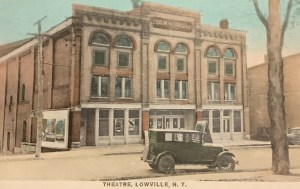
This is the theatre circa 1900.

Please see our first article here on Lowville Town Hall Theatre and its new owner.