


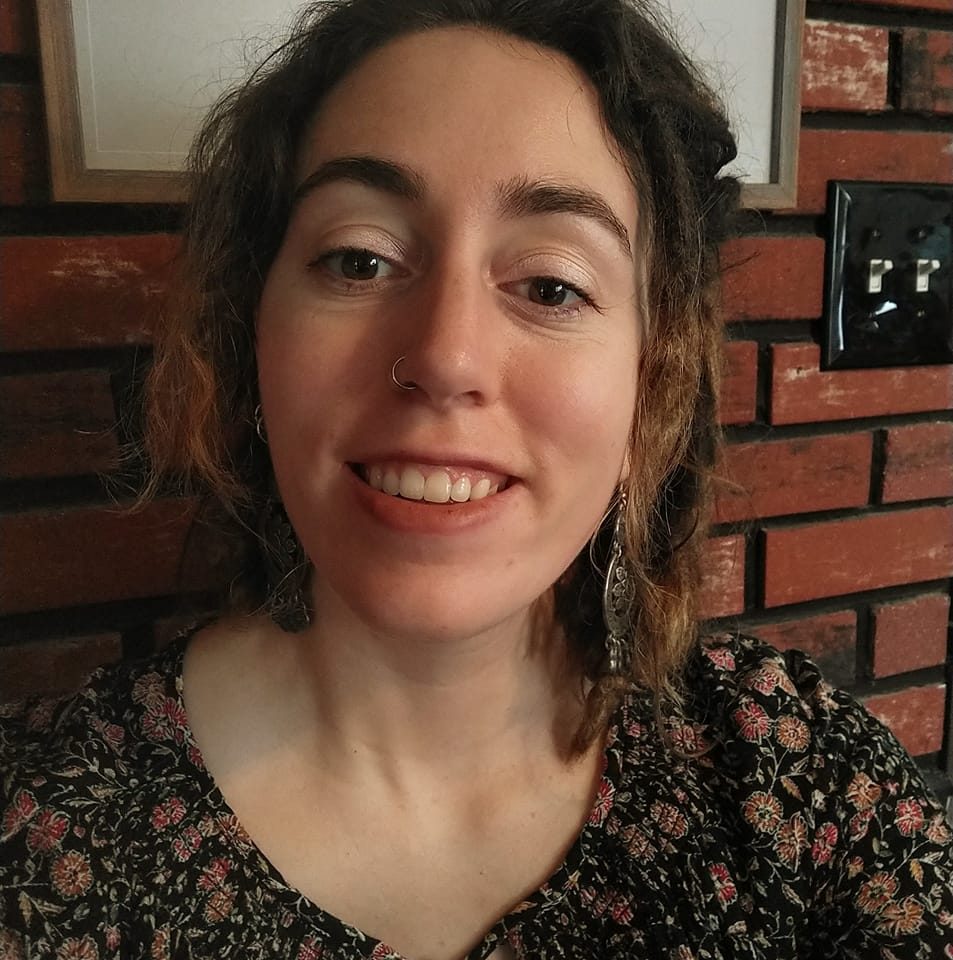
Ashley Oxenford is not only a community organizer; she is a multidisciplinary artist whose work spans poetry, visual art, fiber arts, photography, and music. Her book of poetry, A Jarful of Pebbles, reflects the landscapes and emotional textures of rural life, and her visual and fiber work often explores themes of place, memory, and interdependence.
Her creative voice continues to gain recognition. She will be featured in an upcoming issue of Yokel Magazine, adding to her growing presence in the region’s artistic landscape.
These artistic practices are not separate from her community work—they are the foundation of it. They shape how she sees the world, how she connects with others, and how she imagines a more collaborative future for Tug Hill and its artists.
When Ashley first began her mutual aid project in Carthage called the Community Circle, she was drawing on something rural communities have always known: people survive best when they take care of one another. Long before ‘mutual aid’ became a widely used term, rural towns were practicing it instinctively—neighbors plowing each other’s driveways, families sharing childcare, and farmers trading labor and equipment.
For Ashley, this work is not abstract theory. It is rooted in the way she was raised, the values she inherited, and the creative life she has built across the North Country.
Ashley grew up in a family where the arts and community involvement were simply part of daily life. Her childhood was shaped by creativity, service, and sense of place. Both of her parents were teachers who had grown up in Buffalo, NY, and all her grandparents encouraged artistic expression. Her father, an English teacher and musician, filled their home with stories, literature, and music. Ashley learned piano and trombone because he played them.


Her mother modeled a different kind of creativity: community-building. She volunteered with the local garden club, served on the library board, and followed in the footsteps of her own mother, who believed deeply in service. Ashley grew up in what she calls “a culture of involvement”—a family that was always doing something for others.
At age eight, she moved into an old farmhouse with waterfront and forest. It was a place that offered both solitude and possibility. She had room to explore, to read, to paint, to write. She also spent countless hours outdoors—boating, biking, hiking—absorbing the rhythms of rural life that would later shape her work.
These experiences were formative, but not without complexity. Despite the beauty and freedom of her childhood, Ashley often felt isolated. She struggled to find peers who shared her interests. That changed in college at SUNY Potsdam, an arts-centered environment where she finally found her people. Later, in Utica, she discovered a thriving artist community that reinforced her belief that creativity flourishes in connection.
Returning to the North Country as a teacher, she felt the familiar challenge of finding community again. And she realized she wasn’t alone. Many artists she met were also searching for connection, collaboration, and a sense of belonging.
This longing for connection is part of what inspired Ashley to be a founding member of the Tug Hill Artist Network. What began as a way to gather local creatives has grown into a regional initiative that blends art, mutual aid, and rural resilience.
Her mutual aid work reflects the same values she grew up with—service, creativity, and community care—but now expressed through a broader lens.


In rural places, where services are limited and distances are long, this kind of informal social infrastructure is essential. It is built on trust, relationships, and the simple act of showing up for one another. Ashley sees mutual aid as part of culture—a way of living that rural people have always practiced.
Under the Tug Hill Artist Network, creativity becomes central to this work. Art is not an add‑on; it is the connective tissue.
Rural communities have always expressed themselves through quilts, music, storytelling, woodcraft, murals, and gatherings. Ashley’s vision honors these traditions while creating new pathways for collaboration. By integrating mutual aid with artistic practice, she is helping the region articulate who it is and what it values: self‑reliance balanced with interdependence, creativity in the face of scarcity, and a commitment to ensuring no one is left behind.
This approach also opens doors for young people. Mutual aid gives rural youth a way to lead without waiting for permission. When they see immediate impact—when they help a neighbor, organize a project, or contribute creatively—they learn that leadership doesn’t require leaving. It can happen right here in the Tug Hill region.


In a time when rural America is often framed through narratives of decline, Ashley’s work tells a different story. As she says “Mutual aid reveals rural communities as places of ingenuity, generosity, and collective resilience.”
The Tug Hill Artist Network is part of that story. It is a place where artists, makers, musicians, writers, and neighbors can find one another. A place where creativity becomes a tool for connection. A place where rural identity is not something to overcome, but something to celebrate.


Ashley hopes the network will help build a stronger future for the arts in the region—one where people support each other, grow together, and create the kind of community they’ve been searching for.
And in many ways, she is simply continuing the legacy she was raised with: a life shaped by art, service, and the belief that communities thrive when people care for one another.

Leave a Reply