


Dancing on the Gallows: From Salem to Reclamation
From the systemic isolation of Salem to the vibrant solidarity of modern dancing troupes, a descendant reflects on reclaiming an archetype of resistance.
By Kelley Martin
Halloween is the perfect time of year to tell the story of the Salem witch trials, but we usually reduce it to a cautionary tale or a ghost story. We decorate our lawns with witches, carve pumpkins, and visit haunted attractions. Yet amid the seasonal folklore, we often forget a sobering reality: the women accused of witchcraft were real people. They were mothers, wives, widows, neighbors, and community members whose ordinary lives ended in tragedy.
This past year, the history became deeply personal when I discovered that two of my own ancestors were executed during the 1692 Salem witch trials. Susannah Martin of Amesbury was my tenth great-grandmother on my mother’s side, and Mary Ayer Parker of Andover was my ninth great-grandaunt on my father’s side. Their names transformed Salem from a distant historical event into an intimate family tragedy.

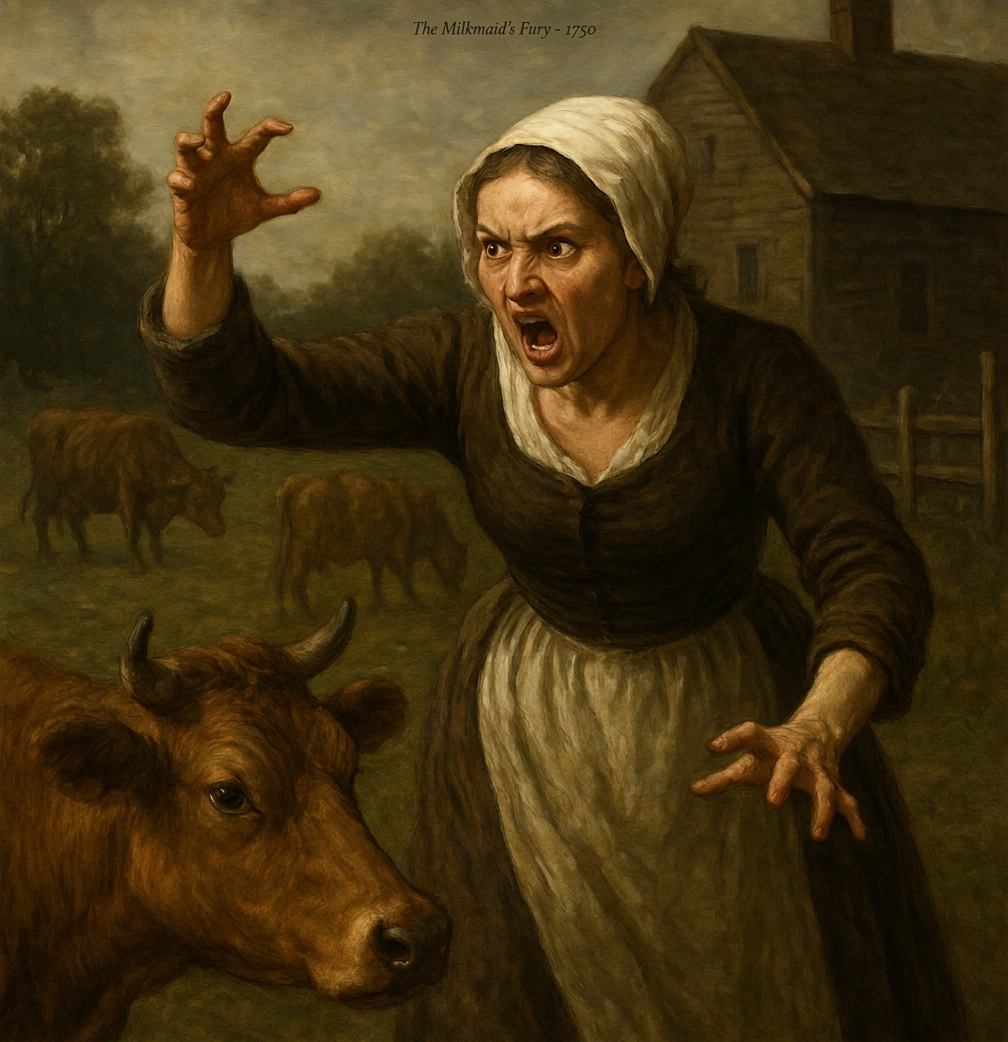
Of the two women, it is Susannah North Martin who most captures my imagination. Long before Salem, Susannah had faced accusations of witchcraft—the word hung over her for 22 years. During that time, her husband George Martin fiercely defended her, pursuing legal action against her accusers until the charges failed. But by 1692, George was dead. Susannah stood entirely alone. She had not changed, but her position in society had. While her husband had once defended her vigorously, she now faced the court as an elderly widow without the social standing and advocacy his presence had provided. Her vulnerability was cemented further after losing out on her inheritance from her father’s contested estate. In a society that placed value on women through their relationships to men, her defenselessness became part of the case against her.
The witch trials unfolded during a period of acute social strain, economic uncertainty, epidemic disease, political instability, and frontier violence. Communities facing that level of fear and uncertainty almost always search for an enemy to blame. Salem’s accused witches became convenient vessels for the anxieties of a community in crisis, with suspicion settling heaviest upon those who already stood at the edges of power.

The historical records from Susannah’s trial illustrate how easily ordinary neighborhood friction could be weaponized into capital crimes. Neighbors she had quarreled with over the years traveled twenty miles to Salem to testify against her. One neighbor blamed an argument over an axe for causing his oxen to run into the sea and drown. Others claimed she could walk through muddy streets without soiling her skirts, or that her “specter” entered their bedrooms at night to pin them to their beds. When she laughed openly at these absurd testimonies in court, the magistrates interpreted her refusal to cower as proof of a wicked and un-submissive spirit.
While Susannah was targeted for her outspoken nature, Mary Ayer Parker’s case reveals a different kind of systemic failure. She appears to have been the victim of extraordinary bureaucratic negligence. During her examination, Mary explicitly told the judges that they had the wrong person, insisting that another woman with the same name lived in Andover. She was correct. At least three other Mary Parkers resided in the area, including a sister-in-law known for severe mental instability and another local woman with a criminal record. Yet the court, relying on the deeply flawed “touch test,” in which afflicted teenagers claimed their convulsions ceased when Mary touched them, refused to investigate any alternative suspects. Instead, vague gossip and the coincidence of a shared name proved sufficient to condemn an innocent woman to the gallows.

The devastation of these trials did not stop at the scaffold; it cast a long shadow of generational trauma over the families left behind. In his 1857 poem “The Witch’s Daughter,” my distant cousin and fellow Susannah Martin descendant, John Greenleaf Whittier, explores this psychological exile through the fictional character of Mabel, a daughter ostracized by her community after her mother is sent to the gallows-tree. Whittier brilliantly captures how a weaponized label forces the next generation into quiet isolation, describing how Mabel must sit apart in the shadows, taunted by neighbors and burdened by “the awful doubts of Providence.” (line 81). While Mabel herself was a literary creation, the trauma she represents was real. For the children of the accused, the community’s collective fear didn’t just steal their mothers—it permanently altered their own safety, standing, and right to belong for generations to come. Although Massachusetts eventually overturned many of the convictions and formally cleared the names of those accused, legal exoneration could never restore the lives, families, and futures that had been taken.
The surviving records of both Susannah and Mary suggest they were not easily intimidated. While others confessed to witchcraft in hopes of saving themselves, they resolutely refused to admit to crimes they did not commit, maintaining their innocence to the very end. In seventeenth-century New England, such independence could be viewed as dangerous behavior.

Before the accusations upended their lives, both had lived according to the rigid scripts written for them. They married, raised large families, endured the hardships of colonial New England, and contributed steadily to their communities. They had checked every box and fulfilled every societal expectation placed upon women of their era. Yet decades of conformity and quiet service offered no protection. When the community fractured, their lifelong utility was erased by a single weaponized label.
Like many women, I have spent much of my life trying to check those same boxes. I built a career helping organizations communicate, organizing, mentoring, advocating, and solving problems while also raising a family. Much of my identity became tied to what I could do for others, and for a long time I believed usefulness and worth were the same thing. I thought that if I simply worked harder and carried more responsibility, then I had value. Eventually, I realized I could no longer define myself solely through service to others. Yet when a woman steps away from her prescribed role as the default caretaker, problem-solver, or fixer, society often interprets that choice as rebellion rather than growth.
This tension is not unique to me; it is a weight countless women carry. We are conditioned to measure our worth by our utility, exhausting ourselves to maintain the social order around us. What happens when a woman refuses to disappear or fall silent once her traditional usefulness has been fulfilled? Historically, the answer was often erasure.
As sociologists Soma Chaudhuri and Jane Ward argue in the Journal of Gender Studies, a striking cultural paradox has emerged across much of the Global North. While many women have reclaimed the figure of the witch as a symbol of empowerment, resilience, and justice, powerful men facing legal scrutiny or public accountability frequently invoke the term “witch hunt” to portray themselves as victims of persecution. This rhetorical inversion reframes the language of historic oppression to protect existing power. By casting accountability-seeking women as the aggressors, it minimizes historical trauma while shielding the very systems that enable contemporary inequality. We see them today.
But the expectations that constrained Susannah, Mary, and generations of women after them are slowly fading, driven by a growing recognition that human worth is inherent rather than transactional. Today, women are answering historical suppression with collective audacity. As scholar Luz Yahaira López Suárez observes, the reimagined figure of the witch has become a powerful symbol of empowerment, self-definition, and justice. By reclaiming this archetype, contemporary women are transforming what was once an instrument of fear into a vehicle for resistance and liberation.
We see this transformation unfolding in public squares across the globe, where women gather not to hide but to take up space loudly and joyfully. Inspired in part by Germany’s Wolfshäger Hexenbrut choreography, modern dancing witch troupes have become visible expressions of female solidarity, creativity, and communal presence. Dressed in vibrant handmade costumes, participants transform parks, festivals, and city streets into celebrations of identity, belonging, and collective joy.
More importantly, many of these groups channel that visibility into service, raising funds for domestic violence programs, animal shelters, community health initiatives, and other organizations that support society’s most vulnerable members. Scholars writing for the interdisciplinary journal Magic, Ritual, and Witchcraft have frequently documented this exact phenomenon: the potent intersection where gender, ritualized performance, and public advocacy meet. There is a profound historical irony in this transformation. The women accused of witchcraft in 1692 were themselves among the least protected members of their communities, vulnerable to rumor, fear, and social exclusion. Today, women reclaiming the witch archetype use it to advocate for and assist others living at the margins. What was once a tool of persecution has become a vehicle for collective care, mutual support, and social action.
Three centuries later, we honor Susannah Martin and Mary Ayer Parker not by remembering the false accusations levied against them, but by recognizing their humanity. They were not cardboard characters or historical ghosts. They were real women who worked, loved, struggled, argued, and survived for as long as they could within the constraints of their world. By refusing to let history reduce them to a single weaponized word, we reclaim their dignity and restore their place in the human story.
The true lesson of Salem is that communities under pressure will often sacrifice their most vulnerable members to soothe their collective fears. But as modern women step into the streets to dance, laugh, support one another, and fund local causes, they offer a powerful answer to that history. In a way, it is easy to imagine Whittier’s fictional Mabel and perhaps one of her real descendants finally stepping out from the lonely shadows, shedding her isolation to join the synchronized spectacle –both dancing on the gallows. When women refuse to be isolated, their independence is no longer treated as a threat—it becomes a source of strength, solidarity, and community care. We are all Susannah Martin. We are all Jane Doe.
References
Generational Literary Context: “The Witch’s Daughter” (John Greenleaf Whittier, 1857)
Contemporary Analysis: Journal of Gender Studies (Chaudhuri & Ward, 2026)
Interdisciplinary Scholarship: Magic, Ritual, and Witchcraft (Project MUSE)
Leave a Reply